Monday, February 7, 2022
Clip art of Saint Julia
Saint Genevieve Clip Art
Clip art of Saint Margaret of Hungry
Saturday, February 5, 2022
Open money bag...
Description of Illustration: tithe, church finances, dedicated money, the cost of living, cash sign, gold or coins spilling from a money bag, black and white sketch of money
Pear Banner in black and white
Here's one thing certain frame!
Christ opens His own tomb from the inside...
Tailpiece of Greek Theater Mask
Tailpiece of Angel With Harp
Monday, January 31, 2022
Serving Up The Soup!
Description of Illustration: Red cross nurse serving soup to soldiers., hot soup bowls, home comforts, soup kitchen
Mary Magdalene, "See, He Is Risen"
Evidently going on ahead, Mary Magdalene saw that the big circular stone had been rolled back along the groove and had left the entrance clear. Hastening to Peter and "the other disciple, whom Jesus loved'' who is thought to be John, she told them, "They have taken away the Lord out of the sepulcher, and we know not where they have laid him'' John 20:2
These disciples followed Mary Magdalene to the sepulcher. John went in first and gazed in silent wonder at the open grave, and then Peter came and saw that the grave was empty and that the linen cerements were lying neatly folded in the empty sepulcher.
One, at least, of the disciples and possibly both of them "saw and believed'' and then went back to their homes. Mary Magdalene, possessing a woman's sensitivity and able to believe even what eyes cannot behold, returned once more to the tomb and looked inside. This time she saw two angels in white sitting there, the one at the head and the other at the feet, where the body of Jesus had lain.
Strange it was that the first word spoken inside the empty tomb should be "Woman.'' And then there followed the angels' question; ''Why weepest thou?'' Mary Magdalene answered, "Because they have taken away my Lord, and I know not where they have laid him" John 20:13. Then she turned, and Jesus stood before her. Not until He spoke her name, "Mary" did she recognize that He was Jesus.
Though she had not found Crist, He had found her and had called her by name. Then she turned to Him with her cry of recognition of her Master; "Rabboni" John 20:16.
As Mary Magdalene stood there in the softly breaking dawn, Jesus had spoken in a voice so tender that it must have penetrated to her heart. "Touch me not; for I am not yet ascended to my Father; but go to my brethren, and say unto them, I ascend unto my Father, and your Father; and to my God, and your God."John 20:17. Mary, awe-stricken, hastened to tell the others that she had seen the Lord and that He had spoken these things to her.
In Christ's resurrection Mary Magdalene had witnessed not a mere resuscitation but a changing to another form, a form not subject to the ordinary laws of the flesh but ready now for a new mode of existence and a new set of relationships, a form not temporal but eternal. Yet He was still alive, active, able to reach out and to speak.
Mary Magdalene went forth to prepare others for this change in their Master. Her long watch by the grave in the early morning had been an evidence of her faith. Because of her faith she became the first witness to the Resurrection.
In a little while followers would see and feel where the nail holes had been in His hands and the spear wound in His side, but they would learn that this body could not be pierced again, for it had taken on an indestructible form.
Who was this Mary Magdalene to whom Jesus appeared after His triumph over death? John gives her the leading part in his narrative. Matthew, however, writes that with her were "'Mary the mother of James and Joses, and the mother of Zebedee's children.'' Matthew 27:56. In 28:1 he writes, ''As it began to dawn toward the first day of the week," Mary Magdalene and "the other Mary,'' who could have been Mary of Cleophas, came "to see the sepulcher.'' Mark tells that "Mary, the mother of James the less and of Joses, and Salome'' accompanied Mary Magdalene (Mark 15:40). Luke gives the prominent place to Mary Magdalene and adds the names of "Joanna, and Mary the mother of James, and other women'' Luke 24:10.
All of this has confused scholars, but evidently Mary Magdalene had a more significant role at the time of the Resurrection than any other woman. Also in several places in the narrative she stands beside the mother of Jesus.
Fourteen times Mary Magdalene is mentioned by name. In eight of these passages her name heads the list. In one her name follows the name of the Mother of Jesus and the other Mary. In five it appears alone. These concern the appearance of Christ to her, as narrated by John.
Where did the name of Mary Magdalene originate? It is derived from Magdala, the Greek form of Migdol or Watchtower. The town of Magdala, from which she came, is identified today as Mejdei, at the south of the Plain of Gennesaret, where the hills reach forth to the lake of Galilee.
We can be confident she was a woman who walked erectly, even to the tomb, one who was young and pretty, well-favored and warmhearted. The master painters have depicted her with auburn hair; probably in her late twenties, she possessed beauty of face and form.
From the Scriptures it is easy to infer that she was one of the influential women of the town of Magdala, who gave of her substance as well as herself to Jesus' ministry, for she had profound gratitude in her heart for His healing of the seven demons with which she had been afflicted (Mark 16:9).
What were these "seven devils?" Some commentators have suggested that they indicate a nervous disorder that had recurred seven times. Others describe them as evil spirits from a superhuman cause.
There is a very strong body of contemporary evidence from highly trained and competent missionaries in the Orient and elsewhere showing that demon possession exists in the areas known to them and exhibits the same phenomenon as that described in the four Gospels. The Chinese, both educated and uneducated, have distinctive terms for the various patterns of mental disorder, but they distinguish the phenomenon of demon possession from other types of mental disorder.
Whatever it was that afflicted Mary Magdalene, Jesus had healed her, and she had become His faithful and devoted follower. Into her living death He had come with the power of life, and had taught her victory over her so-called demons. And after His healing, she had become a fully poised woman, one who could watch at the tomb quietly and unafraid.
Since medieval times Mary Magdalene has been one of the most maligned women in the New Testament, largely because some scholars of an earlier period chose to identify her with the unnamed sinful woman of Luke 7:36-50. The first mention of her in Luke 8:2 follows closely upon this account of the sinful woman. But there is positively no way to identify her as Mary Magdalene. These unfair aspersions have become popular, but they are not at all accurate.
Frank S. Mead in his Who's Who in the Bible says, "We have had Mary Magdalene in the pillory for 1900 years, flinging mud: we should have been pilloried. This Mary was never a harlot; there is no evidence anywhere for that. At most she was neurotic. And Jesus healed her.'' The International Standard Bible Encyclopedia expresses the opinion that "The identification of this Mary with the sinful woman is, of course, impossible for one who follows closely the course of the narrative with an eye to the transition.''
Because of the misinterpretation that Mary Magdalene has suffered at the hands of the few, the Concise Oxford Dictionary gives "reformed prostitute'' as the meaning of "Magdalene.'' Painters, since medieval times, have also made the mistake of depicting Mary Magdalene on canvas as the penitent sinner. Some skeptical writers have descibed her as a paranoic in the habit of "seeing things'' and have declared that what she saw at the tomb was not real.
But if we follow the Scriptures fully, we see a Mary Magdalene who displayed the highest qualities of fortitude in moments of anxiety, courage under trying circumstances, love that could not fail, and humility and unselfish devotion to the Savior who had been crucified. Her faith is a monument to the healing power of Jesus. Her action in serving Him in life and ministering to Him when the mob had turned against Him and had finally left Him in the grave alone is characteristic of woman in Bible history at her best.
The last glimpse of Mary Magdalene as she hastened to the disciples to say "I have seen the Lord." has all the dramatic power of victorious faith. What a magnificent commission hers was, to be a witness to Christ's conquest over death and to be the first to go forth to tell others that she had seen the Lord! No woman ever ran to deliver a more triumphant message.
John makes us realize that Mary Magdalene did not hesitate to do as she had been commanded. She left the grave and forgot her useless spices. A great transformation had taken place in her own being, for she had witnessed a change from the material conception of life to the spiritual, a transformation whereby man was ruled not by the flesh but by the spirit. It is no wonder she could report with firm conviction His words, "I ascend unto my Father'' for she knew the true meaning of His deity and divine exaltation.
Friday, January 28, 2022
A shepherd with a staff...
| "And I will set up over them one shepherd, my servant David, and he shall feed them: he shall feed them and be their shepherd." Ezekiel 34: 23 |
| "I will surely assemble all of you, O Jacob; I will gather the remnant of Israel; I will set them together like sheep in a fold, like a flock in its pasture, a noisy multitude of men." Micah 2:12 |
Have a question about the illustration? Just type it in the comment box and I'll get back to you as soon as possible. I only publish content that is closely related to the subject, folks.
Angel by Fra Angelico
Have a question about the illustration? Just type it in the comment box and I'll get back to you as soon as possible. I only publish content that is closely related to the subject, folks.
Apostles Meet for Last Supper with Jesus
Have a question about the illustration? Just type it in the comment box and I'll get back to you as soon as possible. I only publish content that is closely related to the subject, folks.
Wednesday, January 19, 2022
Manoah's Wife
Manoah's wife (Judg. 13:2, 11, 19, 20, 21, 22, 23) was Samson's mother. She bore no name of her own in the record but is introduced as the wife of a certain Manoah of Zorah, of the family of Danites, and seems to have been a stronger character than her husband. The remarkable thing about her life is that she was told not to drink wine or any strong drink or to eat any unclean thing, for her child would be dedicated to the sacred calling of a Nazarite.
When the angel appeared before her, she was reverent and silent and obedient to the voice and filled with faith, but her husband became fearful and pessimistic, saying, "We shall surely die, because we have seen God.'' Judg. 13:22. But Manoah's wife remained unshaken in her faith. Together, however, they offered up a burnt sacrifice to God in grateful praise. She taught her son that no intoxicating drink should enter his lips and no razor should touch his head, for his long-grown locks would speak outwardly of his sacred vow to God.
Manoah's wife is typical of the wife who has a simple, trusting confidence in God and of the mother who is willing to consecrate herself to all that is good. We can be sure she lived closely to God, for the angel of the Lord appeared both times to her, and each time she made haste and told her husband.
Manoah's wife appears twice in the narrative after Samson is grown. First she and Manoah are protesting because their son has chosen for his wife a woman in Timnath, of the daughter of the Philistines, out of whose hands, it had been foretold before his birth, he would begin to deliver the Israelites. But Samson informed his mother and father that this Philistine woman "pleaseth me well'' Judges 14:3. But they knew their son's marriage was not of the Lord.
Manoah's wife last appears on her way to Timnath to see her son married to the woman to whom she had objected Judges 14:5. The marriage turned out badly, as Manoah and his wife had predicted.
Though Samson was weak where women were concerned, he became one of the most eminent of the Hebrew "Judges.'' Can we not believe that it was to his mother's love and prayers, her dedication of her son to God even before his birth, that he owed his true greatness.?
Was it not the godliness he had inherited from his mother that triumphed in the end? For even at the eleventh hour, when he tore the pillars from their position and brought down the roof upon his foes, the Philistines, did he not atone for all his wasted years? Despite his weakness in character, the New Testament named him one of those Hebrew heroes whose animating principle was faith, a faith such as his godly mother had possessed before her child was born (Heb. 11:32).
Noah's Sons' Wives
Noah's sons' wives (Gen. 7:7, 13; 8:18). Noah's sons, Shem, Ham, and Japheth, all had wives who went with Noah and his wife into the ark, where they dwelt during the flood along with their mother-in-law. These wives and their mother-in-law are the only women of whom we have any record who survived the flood. After that had subsided, the wives went with their husbands and their mother-in-law to the spot where Noah had built an altar unto the Lord. These wives are the mothers of the descendants of Noah mentioned in Genesis 10.
Noah's Wife
Noah's wife (Gen. 6:i8; 7:7, 13; 8:16, 18), in the five times that she is mentioned, is merely among those present, with the sons and sons' wives of Noah. In the first three instances, the sons come first, but in the last two the wife is listed first. There is no record of her, except that as the wife of the hero of the flood, she went with him into the ark made of gopher wood covered inside and out with pitch.
Noah's wife became the first woman on record to make a home on a houseboat in the midst of flood waters. Like her husband, who was a just man and walked with God, probably she too had a deep consciousness of God. Her character is reflected in her family line, which continued strong for 350 years after the flood.
It is interesting to note that Noah's wife played no part in his experience when he discovered the art of making wine and became drunk. He was found drunk by his sons. Probably his wife, had she been living, could have saved him this embarrassment, for this is the only blot on Noah's career.
What did Jesus look like?
Jesus had human flesh that reflected the colors of the people he lived with. He had no remarkable human appearance apart from his own relations. In other words, unless he was speaking, he could not be picked out from the crowd of those he was with. He looked Aramaic/Jewish, from the lands of the Bible. He was and still is often represented in art to look like the people who love him or who wish to use His authority to motivate someone else. The Germanic depiction of Jesus is the most common today. Although, this is due to the preferential choices of publishing companies. They hire the illustrators that they prefer. It has always been true that Western painters portray Jesus as they relate to him. For this reason it is entirely acceptable to paint him as any race that you prefer as long as it is NOT done with the intention to HARM others in any way. However, we live in a fallen society (i.e. the world) and this seems unavoidable at times.
Sunday, January 16, 2022
The Marriage Feast In Cana
THE MARRIAGE FEAST IN CANA
There was a marriage feast in G-alilee;
The festal board was spread with viands
rare;
The joyous guests had met in commune sweet,
And he, the Man of Nazareth, was there.
Yes, he was there, that marriage, Eden-born,
Might share the sanction of his presence
sweet,
That round this holy ritual he might throw
A sacred halo, glorious and complete.
"The wine has failed;" the murmuring word
is passed.
And soon from lip to lip is borne to him;
Then sweeter far than music sounds his voice,
' 'Fill ye these water vessels to the brim."
'Tis done: and wine, rare, purple. rich, and
sweet,
Th' astonished servants, smiling, bear away;
The while, methinks, the wondering guests
repeat,
"Ah, we have seen strange things —
strange things to-day."
New, unferinented wine, the Master made.
Not the mad wine that fills the drunkard's
cup,
But such as he, the bridegroom, gives his
guests
Who at the marriage of the Lamb shall sup,
And drink it new within that kingdom fair —
His Father's glorious kingdom over there.
E'en thus it is along life's rugged path;
Ofttimes it seems the wine of life is spent.
And we have nought to offer those we love
But empty vessels, tears, and discontent.
O let us fill these empty vessels full
With flowing sap, fresh from the living
Vine;
And we shall find, before the feast is done,
That He has turned life's water into wine
The Baptism and Temptation
THE BAPTISM AND TEMPTATION
AT last th' appointed hour has come;
Christ bows 'neath Jordan's swelling wave;
The mighty Baptist leads him forth
Triumphant from that watery grave.
And from the heaven, serene and blue,
While wondering souls with awe are stirred,
A dove-like form appears in view,
Th' Eternal Father's voice is heard:
' 'Lo, this is my beloved Son —
The Prince of Peace, th' Anointed One! "
O holy hour! O sacred spot!
And yet, and yet, they knew him not.
And now the Spirit leads him far
From busy haunts of life away,
Where gloomy shades of darkness are,
'Mong fierce and angry beasts of prey ;
The Holy Spirit bids him go
To wrestle with the wily foe.
There, in that wilderness alone,
With fainting form and pallid face,
Grievous temptations fierce and strong
He suffers, for our fallen race.
But with the Spirit's mighty sword
The prince of hell is put to flight;
The strength of the Eternal Word
Has conquered in Jehovah's might.
O tempted heart! when sorely tried
Amid life's desert, drear and broad,
When hope and strength and courage fail,
Look up, and put thy trust in Grod.
He will not fail thee; he who bore
Temptations fierce and long for thee,
Who in the wilderness prevailed.
Will give thee strength and victory.
In The Temple
IN THE TEMPLE
O'ER Judah's plains sweet Spring had
thrown
Her flowery robe of living green.
And Nature in her gala robes
Was mantled like a fairy queen.
High o'er the temple's burnished towers
The sunshine fell like molten gold,
And flamed and flashed from glittering spire,
From pinnacle and turret old.
While through the city's busy street
Echoed the tread of countless feet.
Far over Judah's hills they come,
From shepherd lad to stately priest,
To ancient Salem's gates they haste
To keep the sacred Paschal Feast.
Look, who is he, that youthful Lad, -
Standing within the temple fair ?
Why do not Israel's sages know
That he — the Paschal Lamb — is there?
Strange blindness, that they knew him not, -
Those gray haired men, those learned
seers:
Useless the Rabbi's studied lore,
The vain philosophy of years.
From out those sacred, youthful lips
Flow wondrous words of heavenly lore, —
Such words of purity and grace
As man had never heard before.
And now, a kind, obedient Son,
No thought had he of earthly fame,
But 'mong the hills of Nazareth
A humble carpenter became.
He took our fallen nature; he
Who made the hosts which roll above
Of Abraham's frail seed partook,
In godlike sympathy and love.
Slaying of The Innocents
SLAYING OF THE INNOCENTS.
Thus one by one the days go by
Since, in the brightening orient sky,
The wise men saw the shining star
Gleam over Bethlehem's hills afar,
And since the shepherd's hearts were stirred
By sweetest song ear ever heard.
But ah ! those echoes scarce had died
O'er Judah's hills and vales so wide, —
Those hills and vales which lately flung
The echoes back from angel tongue, —
Ere, from those selfsame hills, arise
Loud wails of anguish to the skies.
O Herod! heed'st thou not the cry
Of Rachel's anguish, rising high, —
That long, loud wail of mortal pain
From tender babes thy sword hath slain?
Why dost thou raise thy puny arm
To do the Lord's Anointed harm ?
Dost thou not know th' Eternal One
Will shield his well beloved Son?
To far-off Egypt's friendly land
He journeys, led by angel hand;
There, safe from cruel rage, is borne,
While Rama's daughters weep and mourn.
O crafty Herod, vain thy might
When waged against Eternal Right.
Vain, vain shall be thy godless boasts,
Thy conflict with the Lord of Hosts.
Birth
Birth
O'er Bethlehem's hills the stars of night
Were softly shining, clear and bright;
The flocks and herds were sleeping still,
On verdant dale and dewy hill,
And o'er earth's calm and peaceful breast
A benediction seemed to rest,
As though the whole creation knew,
And smiled a welcome warm and true
To Him, her long-expected Lord,
Foretold by Inspiration's Word, —
Foretold and sung by seer and sage,
Bright Star of Hope, from age to age.
Hark, hark! what strains of music rare,
Like faintest perfume fill the air!
And louder still, and still more loud.
Bursts from that swift descending cloud:
Such glorious notes ring o'er and o'er
As weary earth ne'er heard before;
Aloud the heavenly heralds sing.
While through the spheres the echoes ring.
''Glory to God in the highest!
Peace and good will to men!"
And the heavens caught the glad refrain,
And echoed it o'er again.
Then up from the hills of glory
There echoed the thrilling cry,
''Rejoice, O Earth, for the Christ is born!
Glory to God on high!"
Who were Philip's daughters?
Philip's daughters (Acts 21:9) were the four unmarried daughters of the evangelist Philip. They seem to have had the honor of knowing and working for and with the great Christian men and women of their time in Jerusalem, Samaria, and Caesarea. Their father helped to administer the business affairs of the apostles and the growing Church in Jerusalem and to distribute relief to the poor.
They probably assisted him in the latter and were with him when he preached and healed at Samaria and when he led Simon the sorcerer to become an active believer in Christ.
Their mission as prophetesses is mentioned in the narrative telling that Paul's company entered the house of Philip at Caesarea on the Mediterranean. Luke probably stopped at their house also, and it is thought he may have written parts of his Gospel and the Book of Acts there.
Because of their association with the greatest Christian leaders of their time and their own rare spiritual endowments, they became illumined expounders of God's words.
Herodias' Daughter
Herodias' daughter (Matt. 14:6; Mark 6:22) is given no name in the Bible, but Josephus says her name was Salome. The famous opera Salome by Richard Strauss is based on the life of this daughter. She danced before her stepfather Herod Antipas and pleased him so well that he said to her, "Ask of me whatsoever thou wilt, and I will give it thee." Mark. 6:22. The daughter went to her mother and said, "What shall I ask? And the mother made the ghastly request for the head of John the Baptist because he had objected to her divorce from the girl's father and her marriage to his half-brother. The head was brought to the girl on a platter. Her own father was Herod Philip, who was a half-uncle of her mother's and a son of Herod the Great, who sought to destroy the child Jesus.
Saturday, January 15, 2022
"I have eyes for you."
| "I can do all things through him who strengthens me." Philippians 4:13 |
Description of Clip Art: an eye looks over the highway of life, a sign on the road reads, "STOP, Look, Listen, Railroad Crossing," plus cautionary scriptures, grey scale illustration
| Pray then like this: "Our Father in heaven, hallowed by your name." Matthew 6:9 |
| "Blessed are the merciful, for they shall receive mercy." Matthew 5:7 |
| "The point is this: whoever sows sparingly will also reap sparingly, and whoever sows bountifully will also reap bountifully." 2 Corinthians 9:6 |
| "If any of you lacks wisdom, let him ask God, who gives generously to all without reproach, and it will be given him." James 1:5 |
Have a question about the illustration? Just type it in the comment box and I'll get back to you as soon as possible. I only publish content that is closely related to the subject, folks.
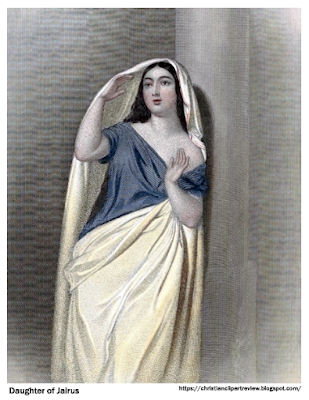
Daughter of Jairus
| Daughter of Jairus. |
The daughter of Jairus (Matt. 9:18-25; Mark 5:35-43; Luke 8: 41-56) was raised from the dead by Jesus. Jairus, her father, was a ruler of a synagogue elected by elders of the community, and it was his duty to look after the order of the divine service. His office was one of the most respected in the community and no doubt his only child of twelve years was loved by all his people.
One day as she lay at the point of death, her father hastened to Jesus, then at Capernaum, beseeching Him to heal her. But as the anxious father spoke with Jesus, a woman who had had an issue of blood for twelve years touched the Master's garment, and the multitude thronged about Him.
This pause must have been a great test of Jairus' patience and faith, for he knew how necessary it was that Jesus hasten to his daughter's bedside. While Jesus paused to speak to the woman, messengers came from Jairus' house saying, "Thy daughter is dead.'' (Mark 5:35). Until then he had besought Jesus to heal his sick child, but now she lay dead. To the mourning Jairus, Jesus spoke the confident words, "Be not afraid, only believe. '' (Mark 5:36).
When Jesus had healed the woman with the issue of blood, he hastened on to the house of Jairus, taking with Him Peter and James and John. Upon entering the house, Jesus found it filled with noisy mourners. Even the flute-players had gathered to play for the last rites of the dead (Matt. 9:23). But Jesus rebuked the mourners, saying, "The damsel is not dead, but sleepeth.'' (Matt. 9:24; Mark 5:39;
Luke 8:52).
Then He went in to where the sick child lay, taking with Him His three disciples. He said to her, "Talitha cumi; which is, being interpreted, Damsel, I say unto thee, arise'' (Mark 5:41).
The Gospel writer, Mark, in his graphic way tells us, "And straightway the damsel arose, and walked.'' And Luke, the physician, makes this comment, "And her spirit came again, and she arose straightway: . . . And her parents were astonished.'' (Luke 8:55, 56) .
In their astonishment, the joyous parents forgot that their daughter needed food, but Jesus did not forget. Turning to them. He commanded that something be given her to eat (Mark 5:43). Her hunger, a natural condition after a long illness, also made Jairus and his wife more aware that their only daughter was not only alive again but fully restored to health.
Though Jesus told her parents to tell no one what had transpired in this room of death, Matthew reports that "the fame hereof went abroad into all that land'' (Matt. 9:26).
Monday, January 10, 2022
Drawings by David Rice
My father was a pastor, a Greek & Roman scholar and an architect. He lived a truly unique and colorful life. In his old age he could not move and was confined to a wheel chair because of Parkinson's disease. However, he could draw and manipulate a pencil up until the last year of his life. I will include a series of drawings that he made for this little blog below.
All graphics/illustrations/clip art on this web journal are free to download and use for personal art projects, church related hard copy or webpages. Images are not to be redistributed in any other collections of clip art online. Please include a link back to this web journal if you use the materials for web articles. Link to htpp://christianclipartreview.blogspot.com
- Help, when least expected..
- Get On Board The Church Bus!
- The Discussion
- Dad's river of smiles
- A little village...
- God's Colorful Congregation
Butterfly Clip Art Index
| Sample butterfly clip art found in the collection below. |
- Philippians 1:6 Framed
- New Life Scriptures + Butterfly
- Orange Butterfly Divider
- Short love verses from Song of Solomon...
- Song of Solomon with Butterflies
- Butterfly resting on a flower
- Romans 8:38-39
- 2 Thessalonians 3:16
- Butterflies Are Free!
- Rejoice Butterfly
- Butterfly With Heart Patterned Wings
- A Symbol of Immortality
Sunday, January 9, 2022
Dove Clip Art Index
| Sample dove clip art found in the collection below. |
All graphics/illustrations/clip art on this web journal are free to download and use for personal art projects, church related hard copy or webpages. Images are not to be redistributed in any other collections of clip art online. Please include a link back to this web journal if you use the materials for web articles. Link to htpp://christianclipartreview.blogspot.com
- Drawing of A Pentecost Dove
- Illuminated Illustration of Pentecost
- The Dove of Pentecost
- Two real looking doves
- The Harp Player Banner
- A small dove frame in liturgical colors...
- Trinity Symbols: Pop Art Style
- Divine Peace
- "I Have Come With A Purpose"
- Confession Clip Art
- Matthew 18:20
- The Flaming IHC
- Colossians 3: 18-19
- Descending Dove
- A Dove on An Easter Egg
- Flood Doves
- Day of Pentecost
Read More About Doves As Symbols in The Christian Faith:
- Dove With An Olive Branch Chrismon
- Combined Triangle, Trinitarian, Dove Symbol
- The Descending Dove or Divine Dove Symbol