Herodias' daughter (Matt. 14:6; Mark 6:22) is given no name in the Bible, but Josephus says her name was Salome. The famous opera Salome by Richard Strauss is based on the life of this daughter. She danced before her stepfather Herod Antipas and pleased him so well that he said to her, "Ask of me whatsoever thou wilt, and I will give it thee." Mark. 6:22. The daughter went to her mother and said, "What shall I ask? And the mother made the ghastly request for the head of John the Baptist because he had objected to her divorce from the girl's father and her marriage to his half-brother. The head was brought to the girl on a platter. Her own father was Herod Philip, who was a half-uncle of her mother's and a son of Herod the Great, who sought to destroy the child Jesus.
Sunday, January 16, 2022
Herodias' Daughter
Saturday, January 15, 2022
"I have eyes for you."
 |
| "I can do all things through him who strengthens me." Philippians 4:13 |
Description of Clip Art: an eye looks over the highway of life, a sign on the road reads, "STOP, Look, Listen, Railroad Crossing," plus cautionary scriptures, grey scale illustration
 |
| Pray then like this: "Our Father in heaven, hallowed by your name." Matthew 6:9 |
 |
| "Blessed are the merciful, for they shall receive mercy." Matthew 5:7 |
 |
| "The point is this: whoever sows sparingly will also reap sparingly, and whoever sows bountifully will also reap bountifully." 2 Corinthians 9:6 |
 |
| "If any of you lacks wisdom, let him ask God, who gives generously to all without reproach, and it will be given him." James 1:5 |
Have a question about the illustration? Just type it in the comment box and I'll get back to you as soon as possible. I only publish content that is closely related to the subject, folks.
Daughter of Jairus
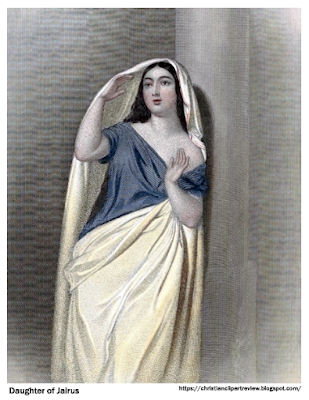 |
| Daughter of Jairus. |
The daughter of Jairus (Matt. 9:18-25; Mark 5:35-43; Luke 8: 41-56) was raised from the dead by Jesus. Jairus, her father, was a ruler of a synagogue elected by elders of the community, and it was his duty to look after the order of the divine service. His office was one of the most respected in the community and no doubt his only child of twelve years was loved by all his people.
One day as she lay at the point of death, her father hastened to Jesus, then at Capernaum, beseeching Him to heal her. But as the anxious father spoke with Jesus, a woman who had had an issue of blood for twelve years touched the Master's garment, and the multitude thronged about Him.
This pause must have been a great test of Jairus' patience and faith, for he knew how necessary it was that Jesus hasten to his daughter's bedside. While Jesus paused to speak to the woman, messengers came from Jairus' house saying, "Thy daughter is dead.'' (Mark 5:35). Until then he had besought Jesus to heal his sick child, but now she lay dead. To the mourning Jairus, Jesus spoke the confident words, "Be not afraid, only believe. '' (Mark 5:36).
When Jesus had healed the woman with the issue of blood, he hastened on to the house of Jairus, taking with Him Peter and James and John. Upon entering the house, Jesus found it filled with noisy mourners. Even the flute-players had gathered to play for the last rites of the dead (Matt. 9:23). But Jesus rebuked the mourners, saying, "The damsel is not dead, but sleepeth.'' (Matt. 9:24; Mark 5:39;
Luke 8:52).
Then He went in to where the sick child lay, taking with Him His three disciples. He said to her, "Talitha cumi; which is, being interpreted, Damsel, I say unto thee, arise'' (Mark 5:41).
The Gospel writer, Mark, in his graphic way tells us, "And straightway the damsel arose, and walked.'' And Luke, the physician, makes this comment, "And her spirit came again, and she arose straightway: . . . And her parents were astonished.'' (Luke 8:55, 56) .
In their astonishment, the joyous parents forgot that their daughter needed food, but Jesus did not forget. Turning to them. He commanded that something be given her to eat (Mark 5:43). Her hunger, a natural condition after a long illness, also made Jairus and his wife more aware that their only daughter was not only alive again but fully restored to health.
Though Jesus told her parents to tell no one what had transpired in this room of death, Matthew reports that "the fame hereof went abroad into all that land'' (Matt. 9:26).
Monday, January 10, 2022
Drawings by David Rice

My father was a pastor, a Greek & Roman scholar and an architect. He lived a truly unique and colorful life. In his old age he could not move and was confined to a wheel chair because of Parkinson's disease. However, he could draw and manipulate a pencil up until the last year of his life. I will include a series of drawings that he made for this little blog below.
All graphics/illustrations/clip art on this web journal are free to download and use for personal art projects, church related hard copy or webpages. Images are not to be redistributed in any other collections of clip art online. Please include a link back to this web journal if you use the materials for web articles. Link to htpp://christianclipartreview.blogspot.com
- Help, when least expected..
- Get On Board The Church Bus!
- The Discussion
- Dad's river of smiles
- A little village...
- God's Colorful Congregation
Butterfly Clip Art Index
 |
| Sample butterfly clip art found in the collection below. |
- Philippians 1:6 Framed
- New Life Scriptures + Butterfly
- Orange Butterfly Divider
- Short love verses from Song of Solomon...
- Song of Solomon with Butterflies
- Butterfly resting on a flower
- Romans 8:38-39
- 2 Thessalonians 3:16
- Butterflies Are Free!
- Rejoice Butterfly
- Butterfly With Heart Patterned Wings
- A Symbol of Immortality
Sunday, January 9, 2022
Dove Clip Art Index
 |
| Sample dove clip art found in the collection below. |
All graphics/illustrations/clip art on this web journal are free to download and use for personal art projects, church related hard copy or webpages. Images are not to be redistributed in any other collections of clip art online. Please include a link back to this web journal if you use the materials for web articles. Link to htpp://christianclipartreview.blogspot.com
- Drawing of A Pentecost Dove
- Illuminated Illustration of Pentecost
- The Dove of Pentecost
- Two real looking doves
- The Harp Player Banner
- A small dove frame in liturgical colors...
- Trinity Symbols: Pop Art Style
- Divine Peace
- "I Have Come With A Purpose"
- Confession Clip Art
- Matthew 18:20
- The Flaming IHC
- Colossians 3: 18-19
- Descending Dove
- A Dove on An Easter Egg
- Flood Doves
- Day of Pentecost
Read More About Doves As Symbols in The Christian Faith:
- Dove With An Olive Branch Chrismon
- Combined Triangle, Trinitarian, Dove Symbol
- The Descending Dove or Divine Dove Symbol
Huldah, "Thus Saith the Lord"
Though many of the Hebrews were given to idolatry and were ignorant of God, still the lamp of divine truth was kept burning in the heart of a woman. That woman was Huldah.
To a high degree, Huldah possessed two great qualities, righteousness and prophetic insight, and because she possessed the former she was able to use the latter wisely. This prophetic power, never trusted to the undeserving, was given to her because she loved God with all her heart.
Evidently Huldah was known in the kingdom of Judah far and wide or she would never have been sought out by King Josiah, who sent five of his own personal messengers to her with the Book of the Law, which had been recently discovered during repairs in the Temple at Jerusalem. He had faith in Huldah's spiritual powers and he wanted her to tell him whether the book was genuine or not. Here is a clue to Huldah's intellectual and spiritual perception.
The Scriptures give us no graphic description of this early Hebrew prophetess, except to say that she was the wife of Shallum, whose family had been singled out as keepers of the wardrobe, meaning either the priest's or the king's wardrobe, probably the latter. At least this would place her close to life inside the palace and Temple.
The King James Version says that Huldah "dwelt in Jerusalem in the college - but the Revised Standard Version says "she dwelt in the Second Quarter'' (II Kings 22:14), indicating the area of Jerusalem in which she lived. On some maps the Second Quarter is shown to be the section in front of the Temple. Jewish tradition has it that Huldah taught publicly in a school. Other tradition has it that she taught and preached to women.
We can justly infer that she was a woman of distinction. Among the messengers that King Josiah sent to her were his high priest, Hilkiah, who had found hidden away this amazing roll of manuscript, the lost Book of the Law, the brilliant work of a group of prophets and priests who had recorded the Yahwistic spiritual ideals. Another messenger was Shaphan, the scribe in the temple, to whom Hilkiah had first taken the lost book. Parts of this book are still found in Deuteronomy. It is now thought to be the first book of the Bible that was canonized.
Only a deeply devout woman, one of real intellectual attainments, would have been sought out by a king and a priest to give her opinion as to whether or not this scroll was indeed the word of the Lord. It turned out to be one of the most important scrolls in the history of Israel.
Huldah not only confirmed its authenticity but also prophesied concerning the future, saying that the Lord would bring evil upon Judah, because the people had forsaken Him and had turned instead to images. As a reward for Josiah's humility and tender heart, Huldah prophesied that he would be gathered unto his fathers before this terrible doom came upon Israel.
Commentators have questioned why King Josiah sent his personal messengers to consult a woman. Why were they not sent to a man? Josiah, who had come to rule at age eight, doubtless had learned to rely a great deal on his mother Jedidah as queen-mother.
We know little about her, but we do know that Josiah's father Amon was murdered in his own palace by his servants because of his idolatry. But King Josiah centralized religion at Jerusalem, exalted the Levites, threw out the shrines of the false gods, and led his people to new spiritual heights. We naturally assume that the godly Josiah had a godly mother. Because of her, he would have a sympathetic appreciation of a woman as righteous and as spiritually discerning as Huldah?
Noteworthy it is that in the short account of Huldah's prophecy the scribe repeated four times her phrase, "Thus saith the Lord'' making us know that Huldah did not think of herself as an oracle, but only as a channel through which God's word came.
Huldah's prophecy gave King Josiah greater courage to put into action the laws written in the Book of the Law, which had been sent to her for verification. After this, Josiah had the scroll read in the house of the Lord and made a covenant to walk after the Lord and to keep his commandments. And because of it, he fought evil in Judah more zealously.
High regard he had for Huldah's prophecy when he acted so promptly, and when he also sought to make himself more worthy of the promised forbearance of God, though he knew the threatened evil to his country and his people could not be averted.
Only a woman who studied immutable spiritual laws and who prayed unceasingly could have been given insight into the mystery of the future. But Huldah was a woman who could throw back the veil of Israel's future because she had lived so close to God.
Jesus Only
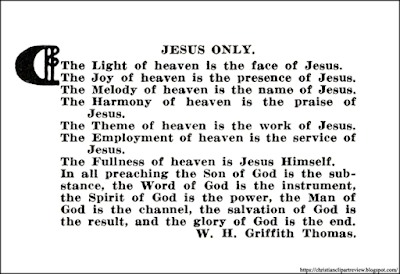
Description of Clip Art: simply framed poem "Jesus Only" by W. H. Griffith Thomas, black and white text
Jesus Only
The Light of heaven is the face of Jesus.
The Joy of heaven is the presence of Jesus.
The Melody of heaven is the name of Jesus.
The Harmony of heaven is the praise of
Jesus.
The Theme of heaven is the work of Jesus.
The Employment of heaven is the service of
Jesus.
The Fullness of heaven is Jesus Himself.
In all preaching the Son of god is the substance,
the Word of God is the instrument,
the Spirit of God is the power, the Man of
God is the channel, the salvation of God is
the result, and the glory of God is the end.
by W. H. Griffith Thomas.
Have a question about the illustration? Just type it in the comment box and I'll get back to you as soon as possible. I only publish content that is closely related to the subject, folks.
Saturday, January 8, 2022
"Do this in remembrance of me."

Have a question about the illustration? Just type it in the comment box and I'll get back to you as soon as possible. I only publish content that is closely related to the subject, folks.
Christian Martyrs Burned Alive in Nero's Court

Description of Illustration: Nero's Torches, also known as Candlesticks of Christianity. Insane Roman emperor who burned Christian martyrs alive at his garden parties.
Have a question about the illustration? Just type it in the comment box and I'll get back to you as soon as possible. I only publish content that is closely related to the subject folks.
Answers to Prayer
Answers to Prayer
Our Savior in the garden wept,
And thrice he prayed to God;
And while his tired disciples slept,
He sweat great drops of blood.
But through the cup his Father gave
Must never pass him by,
Yet strength to bear and power to save
Are sent him from on high.
His servant prayed that God would take
The piercing thorn away;
Yet, though he prayed for Jesus' sake,
The thorn must with him stay.
And yet in answer to his prayer,
A heavenly grace was sent,
To help its agony to bear,
Until his life was spent.
A child is bearing in his hands
A little pack of ware,
But by his side his father stands,
And guards his child with care.
So while the father stands so near,
To shield from rude alarms,
His child, when faint or filled with fear
He gathers in his arms.
'Tis thus our heavenly Father cares
For those who love his name;
He hears their oft-repeated prayers,
And loves them just the same.
And those who have some thorn or load
That seems too hard to bear,
He guards them all along the road
With a more watchful care.
"All the earth doth worship thee the Father.."

Description of Illumination: Illuminated hymn text "All the earth doth worship thee the Father everlasting." The "Te Deum is a Latin Christian hymn traditionally ascribed to AD 387 authorship, but with antecedents that place it much earlier. The illumination consists of a diamond-shaped centre upon a crossed pattern or diaper of Egyptian origin, which was extensively used for glass painting.
Have
a question about the illustration? Just type it in the comment box and
I'll get back to you as soon as possible. I only publish content that is
closely related to the subject folks.
Tuesday, January 4, 2022
Fishing for people...

Description of Clip Art: mosaic of fisherman and fish, scripture "Jesus called out to them, 'Come, follow me, and I will show you how to fish for people.' Matthew 4:19
Have a question about the illustration? Just type it in the comment box and I'll get back to you as soon as possible. I only publish content that is closely related to the subject folks.
4 Verses about the Holy Spirit at work...
1.) His witness with us of Sonship.
"Salute Andronicus and Junia, my kinsmen, and me fellow-prisoners, who are of note among the apostles, who also were in Christ before me. Greet Amplias my beloved in the Lord." Romans 16: 7-8 (KJV)
2.) His testimony through us to the world.
"But very truly I tell you, it is for your good that I am going away.
Unless I go away, the Advocate will not come to you; but if I go, I will
send him to you. When he comes, he will prove the world to be in the wrong about sin and righteousness and judgment: about sin, because people do not believe in me; about righteousness, because I am going to the Father, where you can see me no longer; and about judgment, because the prince of this world now stands condemned." John 16:7-11 (NIV)
3.) His guidance of us into Truth.
"But as for you, the anointing (the sacred appointment, the unction) which you recieved from Him abides (permanently) in you; (so) then you have no need that anyone should instruct you." 1 John 2: 27 (TAB)
"But when He, the Spirit of Truth (the Truth-giving Spirit) comes, He will guide you into all the Truth (the whole, full Truth). For He will not speak His own message (on His own authority): but He will tell whatever He hears (from the Father; He will give the message that has been given to Him), and He will announce and declare to you the things that are to come (that will happen in the future). He will honor and glorify Me, because He will take of (recieve, draw upon) what is Mine and will reveal (declare, disclose, transmit) it to you." John 16: 13-14 (TAB)
4.) His leadership of us in service.
" And when they fasted and prayed, and laid their hands on them, they sent them away. So they, being sent forth by the Holy Ghost, departed unto Seleucia and from thence they sailed to Cyprus." Acts 13: 3-4 (KJV)
Blank Ribbon Title

Description of Clip Art: black and white scroll work, ribbons, superimpose your own words, lettering, give your work, writing, index a fancy title graphic...
Have a question about the illustration? Just type it in the comment box and I'll get back to you as soon as possible. I only publish content that is closely related to the subject folks.
Buried in his books...

Description of Illustration: An old scholar searches through his stacks of books. A very cluttered library of thoughts, facts, and imaginings..., black and white illustration of a bibliophile
Have a question about the illustration? Just type it in the comment box and I'll get back to you as soon as possible. I only publish content that is closely related to the subject folks.
Only Waiting . . .
Only Waiting...
Only waiting till the shadows
Are a little longer grown;
Only waiting till the glimmer
Of the day's last breath is flown.
Till the night of earth is faded
From the heart once full of day;
Till the stars of heaven are breaking
Through the twilight soft and gray.
Only waiting till the reapers
Have the last sheaf gathered home;
For the summer time is faded,
And the autumn winds have come.
Quickly, reapers! gather quickly
The last ripe hours of my heart,
For the bloom of life is withered,
And I hasten to depart.
Only waiting till the angels
Open wide the mystic gate,
By whose side I long have lingered,
Weary, poor and desolate.
Even now I hear their footsteps,
And their voices far away;
If they call me, I am waiting,
Only waiting to obey.
Only waiting till the shadows
Are a little longer grown;
Only waiting till the glimmer
Of the day's last beam is flown;
Till from out the gathering darkness
Holy, deathless stars shall rise,
By whose light my soul shall gladly
Tread its pathway to the skies.
Who were the 400 outstanding wives in the book of Judges?
Four hundred young virgins from Jabesh-Gilead (Judg. 21:12-23) were brought into the camp at Shiloh and given as wives to the defeated Benjamites. This incident followed the war started over the Ephraim Levite s concubine, who had been ill-treated by the wicked Sons of Benjamin, who had no wives.
Grieved that the tribe of Benjamites was now nearly destroyed, the Israelites received them into their favor and found them wives from among their own daughters. After the Benjamites received the four hundred young virgins as wives, they went and repaired their cities and dwelt in them.
Here is a striking example of how good wives can be the civilizers of men, thus influencing them away from evil into that which is good.
Who was Machir's wife?
Machir's wife (I Chron. 7:15) was in the line of Zelophehad, who had the five distinguished daughters who declared their property rights.
"Makir took a wife from among the Huppites and Shuppites. His sister’s
name was Maakah. Another descendant was named Zelophehad, who had only
daughters." 1 Chronicles 7:15
Who was Artaxerxes' Queen?
The queen who sat beside Artaxerxes (Neh. 2:6) is only briefly mentioned when Nehemiah came before the king to ask for the commission to build again the wall of Jerusalem.
"Then the king, with the queen sitting beside him, asked me, “How long
will your journey take, and when will you get back?” It pleased the king
to send me; so I set a time." Nehemiah 2:6
Who was Job's wife?
Job's wife (Job 2:9; 19:17; 31:10) has been called everything from the "adjutant of the devil" (St. Augustine) to the "faithful attendant upon her husband's misery" (William Blake). She is introduced after Job, one of the richest and greatest men of his time, has been bereft of his cattle, flocks, camels, and all his children. Moreover, he is suffering from a loathsome disease, probably leprosy.
As he sat on an ash heap outside the city walls, Job still did not blame God. His wife, probably not so faithful and certainly not so patient, cried out, "Dost thou still retain thine integrity? Curse God, and die." Job 2:9 No doubt Job's wife regarded a quick death as better than long-drawn-out suffering. In those days sudden death was supposed to result from cursing God.
In this statement we see Job's wife as an ordinary, normal woman. Though a dutiful wife, she probably failed to suffer with her husband in his hour of agony and consequently failed to share with him the marvelous victory of trusting God in spite of not understanding Him.
There is another side, however, to Job's wife. She had endured her husband's affliction, even the loss of all their children and all their material possessions, and had survived these trials. Like her husband, she was bewildered amid so much calamity. Such a piece of advice as she gave him in his affliction could have been inspired by sympathy and love. Probably she would rather have seen him die than endure such great suffering.
In the next scene where she is depicted, we find her turning from her husband (Job 19:17), because his breath is so offensive on account of the disease from which he suffered.
Though Job's wife is not mentioned in the closing chapters, we learn in 42:14 that three daughters, Jemima, Kezia, and Keren-hap-puch, as well as sons, were later born to him. Probably Job's wife arose to new joy, just as he did, and regretted her own lack of faith when she had advised him to "curse God, and die."
Who was Ezekiel's wife?
Ezekiel s wife (Ezek. 24:16, 17, 18) is referred to as the desire of his eyes. The wife of this prophet-priest of the sixth century B. C. was taken quite suddenly with a stroke. Ezekiel was warned that this would happen but was forbidden to perform the customary mourning rites.
He restrained his tears and went forth to preach, probably the morning after he had been told that he would lose his wife. In the evening she died. But that morning he spoke to his people on the coming destruction of Jerusalem, when they also would lose loved ones, but he told them that they too must abstain from any outward signs of mourning. Ezekiel's own great grief, only a few hours away, enabled him to speak with greater conviction to those who looked to him for spiritual guidance.
Doubtless Ezekiel's wife was a godly woman who had helped him serve his small, remote congregation. Their home was a little mud-brick house in a colony of exiles at Tel-abib on the Chebar, an important canal in the Euphrates irrigation system (Ezek. 3:15).
Who were the wives that burned incense to false gods?
Wives who burned incense to other gods (Jet. 44:15) were Hebrew women who had left Judah and had fled to Pathros, a province of the land of Egypt. They were rebuked by Jeremiah for their idolatrous worship. He forewarned them of the dreadful evils that would befall them if they persisted in their false worship.
These women presumptuously declared it was their intention to continue in the same course, to burn incense unto the queen of heaven, as their fathers had done before them. They saw no evil in such a practice (Jer. 44:19).
Who is the unbelieving wife?
The unbelieving wife (I Cor. 7:14), says Paul to the Corinthians, is sanctified by her husband. Though he is a Christian and she is not, his belief sanctifies the union. Paul goes on to say that the faith of one Christian parent gives to the children a near relationship to the Church, just as if both parents were Christians. The children are regarded not as aliens to the Christian faith but as sharers in it. Paul presumed that the believing parent will rear the child in the Christian principles.
He makes the same point in regard to husbands, saying that "The unbelieving husband is sanctified by the wife." I Corinthians 7:14
Who was the wife that was to be sold for a debt?
The wife who was to be sold for debt (Matt. 18:25) appears in Jesus' parable of the unforgiving servant and illustrates the principle of the Lord's Prayer, "Forgive us our debts, as we forgive our debtors.''
Here Jesus is comparing our heavenly Father to a king who wished to settle accounts with his servants. One was brought to him who owed him ten thousand talents (approximately ten million dollars). When the servant could not pay, the king ordered him to be sold, with his wife and children and all that he had. The servant begged the king to have patience with him, and the king, moved with compassion, loosed his servant and let him go.
But the servant went forth and cast into prison a fellow servant who owed him a very small debt. Then the king called back the servant he had forgiven of his large debt and asked why he had not showed the same compassion to his fellow servant that had been shown to him. The man was then jailed until he should pay all that he owed.
Jesus, concluding the parable, said, "So likewise shall my heavenly Father do also unto you, if ye from your hearts forgive not every one his brother their trespasses." Matthew 18:35
The Old Testament tells of selling people into slavery to pay a debt (Amos 2:6; 8:6; Neh. 5:4, 5), but this is the only reference of a woman's being sold, along with her children, to pay a debt.
Did the apostle Peter have a wife?
Peter's wife (Matt. 8:14; Mark 1:30; Luke 4:38; I Cor. 9:5) no doubt witnessed her mother's healing. Since Jesus probably used Peter's home as headquarters when in Capernaum his wife must have seen Jesus often. She is referred to as Simon's or Cephas' wife. She traveled with him as did the wives of other apostles.
Naaman's wife and her little Israelite maid...
 |
| Naaman's Little Maid. |
Naaman's wife (II Kings 5:2) had waiting on her a little Israelite maid, who had been captured in a border skirmish. Though Naaman was the successful commander-in-chief of Ben-hadad and had received many military honors and known much good fortune, he was now afflicted with leprosy. Through the maid's sympathetic interest in Naaman's condition he learned of Elisha's healing power. She probably told Naaman's wife, who carried the information to her husband, after which he went to Elisha, and was healed, and accepted the God of Israel as the "only God in all the earth."
Though Naaman's wife is the background figure in the incident, at least she became a channel for God's healing, because she had the faith to listen to a little maid in her household, insignificant though she was.
Who was Jeroboam's wife?
Jeroboam's wife (I Kings 14:2, 4, 5, 6, 17) was the queen who went to the prophet Ahijah to inquire whether her sick son would recover. Her husband, Jeroboam, first king of the northern kingdom of Israel, was an apostate who had led his people away from the faith and worship of their fathers. He had calf shrines built for heathen worship, but when his son became ill, he longed for help in his son's healing.
Guilty because of his treatment of the priests of the Lord, Jeroboam told his wife to disguise herself in the dress of an ordinary woman when she went to see the prophet. Jeroboam also directed his wife to take the sort of gifts that an ordinary woman might offer, such as ten loaves and cracknels (crisp biscuits and pork crisply fried) and a cruse of honey, for it was customary to take a gift, however small, when advice or God's word was sought from a. prophet.
The queen did disguise herself, as her husband had advised, and went to Shiloh, but when she arrived there, the aged and blind prophet, forewarned by the Lord of her coming, said, "Come in, thou wife of Jeroboam; why feignest thou thyself to be another? For I am sent to thee with heavy tidings." I Kings 14:6 He then proceeded to tell her to go back and tell her husband that, because he had made other gods and molten images, he had provoked God, and his house would be visited with evil.
The prophet further prophesied to Jeroboam's wife that when she returned home her child would die, but all Israel would mourn him. Her child would be the only one of the house, however, to be laid in a grave, because there was some good "toward the Lord." in him. Others of the house of Jeroboam would be eaten by dogs or by fowls of the air. Jeroboam's wife arose and departed and when she came to her threshold her child died, and they buried him, and all Israel mourned.
Tahpenes' sister was Hadad's wife...
The sister of Tahpenes (I Kings 11:19, 20) was the wife of Hadad, son of the king of Edom. Tahpenes was queen consort of Pharaoh of Egypt and a contemporary of Solomon, king of Israel. Scripture tells us that when David and Joab were at Edom, every male Edomite was slain except a youth named Hadad and some of his father's servants. The young Hadad fled to Egypt, where he was favorably received by Pharaoh, who gave him the sister of his wife in marriage. She gave birth to Genubath, who was brought up by Tahpenes among Pharaoh's children. It might be inferred that this sister died in childbirth.
Monday, January 3, 2022
Athaliah, only woman ever to rule over Judah...
"Women are ever extreme; they are better or they are worse than men." history has often testified. Athaliah, the only woman ever to sit on the throne of David and rule, was the extreme in wickedness.
Evil ran in her veins. She was the granddaughter of Omri, who waded through slaughter to a throne he never inherited. She was the daughter of Ahab, the legitimate successor of his unscrupulous father, and of Jezebel, whose name is synonymous with wickedness. Reared in the northern kingdom of Israel, at Samaria, where the palace of her parents was surrounded by groves and idols of Baal worship, Athaliah grew up in an atmosphere that completely denied the one God. Because of the lewd cult worship of Baal, introduced by her mother, the kingdom was swept by immorality and godlessness.
Athaliah, probably for political expediency, was married to Jehoram, eldest son of the pious Jehoshaphat, king of Judah. She went with him to Jerusalem, capital of the southern kingdom. When he was thirty-two years old, he came to the throne, and Athaliah sat beside him. Just as her mother had done when she came to Samaria from Tyre, Athaliah promoted her Baal worship among the people. Because her husband's brothers were loyal to the faith of their nation. King Jehoram had them murdered. Athaliah, much more determined in character than her husband was, probably instigated these murders.
Jehoram reigned eight years and died unmourned of an incurable disease foretold by Elijah. The Philistines had captured all his secondary wives and sons, except Ahaziah, Athaliah's own son, who now came to the throne. As queen-mother, Athaliah was more powerful than ever. Her son was young and she had had the experience of dictating through her husband. We have the record that Ahaziah "walked in the ways of the house of Ahab: for his mother was his counselor to do wickedly" II Chronicles 22:3
Within a year Athaliah's son was wounded in his chariot by Jehu, commissioned by Elijah to overthrow the dynasty of Athaliah's father. Her son escaped to Megiddo, where he died. Athaliah seized the throne and resolved to destroy "all the seed royal" her own blood relations, among whom were her own grandchildren. Had one of these young princes become king, her place as queen-mother would have been usurped. She also knew that if she had the power of chief ruler she could further promote her Baal worship.
Judah had six years of unrighteous government under Athaliah. From II Chronicles 24:7 we can assume that she even had a portion of the Temple of Jehovah pulled down. And she used the material in the building of a temple of Baal.
Fortunately for the kingdom of Judah, Jehosheba, her step-daughter, had rescued Joash, one of the royal infants, from her bloody massacre at the time she came to the throne. Jehosheba had hidden the child for six years, and at the proper time her husband, the high priest Jehoiada, brought forth the lad, now seven years of age. With the aid of mighty men, he proclaimed him king.
When Queen Athaliah heard the people celebrating the young king's accession in the temple, she went there and screamed, "Treason, Treason "II Chron. 23:13 The high priest ordered that she be slain, not in the house of the Lord, but after she had left it. She was therefore slain as she was entering the horses' gate by the palace, close by the Temple.
The horses trampled over her body where she lay dead at the gates. In her miserable end, Athaliah bore a singular resemblance to her mother Jezebel, who was abandoned to the dogs. Athaliah was left in a horse-path, to be trampled upon. Like her mother she died a queen, but without a hand to help her or an eye to pity her.
The final Biblical record alludes to Athaliah as "that wicked woman" II Chron. 24:7 Jean Baptiste Racine's tragedy Athalie, written at the instigation of Madame de Maintenon and first performed at Versailles in 1690, is based on the life of this wicked queen, who lived the latter part of the eighth century before Christ.