Wednesday, June 7, 2017

The Trinity Fish Symbols

       This trinity fish symbol is very old and not in common use anymore, except for it's use on Chrismon trees. This is because Chrismon trees depict the histories of many people.
       Some sources say that the converted Celtic Christians used this symbol prior to becoming Christians and then transferred it to Trinity worship because it represented the God the Father, God the Son, and God the Holy Spirit so perfectly. 
       Symbolic language in ancient times did change throughout history. Just as meanings attached to much of our own vocabulary changes over time. This is not a strange phenomena, in fact, it happens all of the time. In order to correctly establish meanings behind symbols, one should contextualize them for the time, place and their use by the people who used them. 
       The Lord brought many gentiles into his church and with this gift came much cultural heritage. This does not mean that every symbol that has former history must be eliminated from our memory. It does require, however, that that history be understood, taught and valuable lessons be learned from it.

       Above and below two more variations of Trinity Fish for visitors to use in Chrismon crafts.

The Sacred Heart Symbols

       There are two Sacred Heart symbols here, on top is the symbol standing for Jesus. His heart is embraced by a thorny crown. This crown is an illusion to the crown of suffering worn by him during his humiliation before the cross. The flames coming from the heart symbolize Christ's passion for his people and The passion story relating to the last days of his life on Earth. 
       The sacred heart below belongs to Mary the mother of Jesus. We know this because of the lily that blooms through it's top and the crown of roses that encircle it's heart shape. Roses are often used in Christian symbolism to represent Mary. Lilies are symbolic of the Annunciation. Both symbols are distinct to Catholicism. 

The devotion to the Sacred Heart (also known as the Most Sacred Heart of Jesus, Sacratissimi Cordis Iesu in Latin) is one of the most widely practiced and well-known Roman Catholic devotions, taking Jesus Christ's physical heart as the representation of his divine love for humanity. Read more...
Scripture References for Sacred Heart Chrismons:
  • "As water reflects the face, so one’s life reflects the heart." Proverbs 27:19 (NIV)
  • "Create in me a pure heart, O God, and renew a steadfast spirit within me." Psalm 51:10 (NIV)
  • Jesus replied: ‘Love the Lord your God with all your heart and with all your soul and with all your mind.’ Matthew 22:37 (NIV)
  • "Blessed are those who keep his statutes and seek him with all their heart." Psalm 119:2 (NIV)

Saturday, June 3, 2017

The Thistle Symbol

       The Thistle is symbolic for chivalry and long suffering endurance. Over time, the meaning of chivalry has been refined to emphasize social and moral virtues more generally. However, the code of chivalry, as it stood by the Late Middle Ages, was a moral system which combined a warrior ethos, knightly piety, and courtly manners, all conspiring to establish a notion of honor and nobility.
       Understanding this medieval definition of chivalry is very important when interpreting the symbolism behind the thistle. Royal families in both Scotland and France have long associated the symbol with their own heraldry because of it's links to chivalry.
       In origin, the term chivalry means "horsemanship", formed in Old French, in the 11th century, from chevalier (horseman, knight), from Medieval Latin caballārius. The French word chevalier originally means "a man of aristocratic standing, and probably of noble ancestry, who is capable, if called upon, of equipping himself with a war horse and the arms of heavy cavalryman and who has been through certain rituals that make him what he is". In English, the term appears from 1292 (note that cavalry is from the Italian form of the same word).
       The meaning of the term evolved over time because the word chevalier was used differently in the Middle Ages, from the original concrete military meaning "status or fee associated with military follower owning a war horse" or "a group of mounted knights" to the ideal of the Christian warrior ethos propagated in the Romance genre, which was becoming popular during the 12th century, and the ideal of courtly love propagated in the contemporary Minnesang and related genres. Thus, chivalry has hierarchical meanings from simply a heavily armed horseman to a code of conduct.
       The ideas of chivalry originated in three medieval works: the anonymous poem Ordene de Chevalerie, that tells the story of how Hugh II of Tiberias was captured and released upon his agreement to show Saladin (1138-1193) the ritual of Christian knighthood, the Libre del ordre de cavayleria, written by Ramon Lull (1232-1315), whose subject is knighthood, and the Livre de Chevalerie of Geoffroi de Charny (1300-1356), which examines the qualities of knighthood, emphasizing prowess. Based on the three treatises, initially chivalry was defined as a way of life in which three essential aspects fused together: the military, the nobility, the religion.
       The "code of chivalry" is thus a product of the Late Middle Ages, evolving after the end of the crusades partly from an idealization of the historical knights fighting in the Holy Land, partly from ideals of courtly love.

Gautier's Ten Commandments of chivalry are:
  1. Thou shalt believe all that the Church teaches and thou shalt observe all its directions.
  2. Thou shalt defend the Church.
  3. Thou shalt respect all weaknesses, and shalt constitute thyself the defender of them.
  4. Thou shalt love the country in which thou wast born.
  5. Thou shalt not recoil before thine enemy.
  6. Thou shalt make war against the infidel without cessation and without mercy.
  7. Thou shalt perform scrupulously thy feudal duties, if they be not contrary to the laws of God.
  8. Thou shalt never lie, and shalt remain faithful to thy pledged word.
  9. Thou shalt be generous, and give largesse (to pay/make tithes, taxes and charitable contributions) to everyone.
  10. Thou shalt be everywhere and always the champion of the Right and the Good against Injustice and Evil.
      Though these ten commandments are often accepted to be what knights would use, they would not necessarily be what a knight actually followed in the medieval era. This code was created by Leon Gautier in 1883, long after the knight had ceased to exist in its traditional form. Chivalry in a historical sense was more of a subjective term, these laws would likely be seen as good code for a clergyman, however others would hold different ideas on what chivalry truly was.
       All of these ideas about codes of conduct and chivalry where directly linked to the persona of Christ by medieval Christendom. Both the thorns of the thistle and the lavender colored crowning top of petals as seen on the flower's bud (head) served as reminders of Jesus' authority in Heaven and on Earth. In fact, Jesus wears both a crown of thorns and a royal purple robe in many of the carvings, stained glass windows, paintings, engravings, etc... depicted in his churches across the Western world.

Scriptural References for the Thistle Chrismon:
  1. He answered, "'Love the Lord your God with all your heart and with all your soul and with all your strength and with all your mind'; and, 'Love your neighbor as yourself.'" Luke 10:27 (NIV)
  2. "But in your hearts revere Christ as Lord. Always be prepared to give an answer to everyone who asks you to give the reason for the hope that you have. But do this with gentleness and respect," 1 Peter 3:15 (NIV)
  3. "Blessed are those who have regard for the weak; the LORD delivers them in times of trouble.
    "
    Psalm 41:1 and "Blessed are the meek, for they will inherit the earth." Matthew 5:5 (NIV)
  4. "Honor the LORD with your wealth, with the firstfruits of all your crops;" Proverbs 3:9 (NIV)
  5. "But I tell you, love your enemies and pray for those who persecute you," Matthew 5:44 (NIV)
  6. "For our struggle is not against flesh and blood, but against the rulers, against the authorities, against the powers of this dark world and against the spiritual forces of evil in the heavenly realms." Ephesians 6:12 (NIV)
  7. "Then Jesus said to them, "Give back to Caesar what is Caesar's and to God what is God's." And they were amazed at him." Mark 12:17 (NIV)
  8. "You shall not give false testimony against your neighbor." Exodus 20:16 and "Then you will know the truth, and the truth will set you free." John 8:32 (NIV)
  9. "'If any of your fellow Israelites become poor and are unable to support themselves among you, help them as you would a foreigner and stranger, so they can continue to live among you." Leviticus 25:35 and ""Do not store up for yourselves treasures on earth, where moths and vermin destroy, and where thieves break in and steal. But store up for yourselves treasures in heaven, where moths and vermin do not destroy, and where thieves do not break in and steal." Matthew 6:19-21 (NIV)
  10. "Declare what is to be, present it-- let them take counsel together. Who foretold this long ago, who declared it from the distant past? Was it not I, the LORD? And there is no God apart from me, a righteous God and a Savior; there is none but me." Isaiah 45:21 (NIV)

Friday, June 2, 2017

Luther's Rose From 1530

Luther's Rose is always depicted as snow white or
 as having very pale shades of color reflected into it.
        The Luther rose was the seal that was designed for Martin Luther at the behest of Prince John Frederick, in 1530, while Luther was staying at the Coburg Fortress during the Diet of Augsburg.

In a July 8, 1530 letter to Lazarus Spengler, Luther interprets his seal:
Grace and peace from the Lord. As you desire to know whether my painted seal, which you sent to me, has hit the mark, I shall answer most amiably and tell you my original thoughts and reason about why my seal is a symbol of my theology. The first should be a black cross in a heart, which retains its natural color, so that I myself would be reminded that faith in the Crucified saves us. "For one who believes from the heart will be justified" (Romans 10:10). Although it is indeed a black cross, which mortifies and which should also cause pain, it leaves the heart in its natural color. It does not corrupt nature, that is, it does not kill but keeps alive. "The just shall live by faith" (Romans 1:17) but by faith in the crucified. Such a heart should stand in the middle of a white rose, to show that faith gives joy, comfort, and peace. In other words, it places the believer into a white, joyous rose, for this faith does not give peace and joy like the world gives (John 14:27). That is why the rose should be white and not red, for white is the color of the spirits and the angels (cf. Matthew 28:3; John 20:12). Such a rose should stand in a sky-blue field, symbolizing that such joy in spirit and faith is a beginning of the heavenly future joy, which begins already, but is grasped in hope, not yet revealed. And around this field is a golden ring, symbolizing that such blessedness in Heaven lasts forever and has no end. Such blessedness is exquisite, beyond all joy and goods, just as gold is the most valuable, most precious and best metal. This is my compendium theologiae [summary of theology]. I have wanted to show it to you in good friendship, hoping for your appreciation. May Christ, our beloved Lord, be with your spirit until the life hereafter. Amen.
Scripture Reference for Luther's Rose:
  • "for with the heart man believes, resulting in righteousness, and with the mouth he confesses, resulting in salvation." Romans 10:10 (NAS)
More About The Lutheran Rose:

Thursday, June 1, 2017

The Escallop Sea Shell

 The Escalop-shell, when used in Christian art, signifies two ideas: baptism and pilgrimage. It is both the usual emblem of that Holy Sacrament and the emblem of pilgrims.
Scripture References for the Escallop Sea Shell:
  • "those who disobeyed God long ago when God waited patiently while Noah was building his boat. Only eight people were saved from drowning in that terrible flood. And that water is a picture of baptism, which now saves you, not by removing dirt from your body, but as a response to God from a clean conscience. It is effective because of the resurrection of Jesus Christ." 1 Peter 3:20-21 (NLT)
  • "Or do you not know that all of us who have been baptized into Christ Jesus have been baptized into His death? Therefore we have been buried with Him through baptism into death, so that as Christ was raised from the dead through the glory of the Father, so we too might walk in newness of life." Romans 6:3-4 (NASB)
  • "At that time Jesus came from Nazareth in Galilee and was baptized by John in the Jordan Just as Jesus was coming up out of the water, he saw heaven being torn open and the Spirit descending on him like a dove." Mark 1: 9-10 (NIV)
  • "That if thou shalt confess with thy mouth the Lord Jesus, and shalt believe in thine heart that God hath raised him from the dead, thou shalt be saved. For with the heart man believeth unto righteousness; and with the mouth confession is made unto salvation." Romans 10: 9-10 (KJB)
  • "Therefore go, and make disciples of all nations, baptizing them in the name of the Father and of the Son and of the Holy Spirit, teaching them to observe all things that I commanded you. And look, I am with you every day, even to the end of the age." Matthew 28: 19-20 (NHEB)
Escallop in a medallion.

Hymns - Praise and Worship Music:
Know more baptism hymns? Why not share in the comments below?

Embroider a Red Rose to Represent Christ's Passion

A Passion Rose on a Chrismon tree, has red petals
 with either gold, white or silver stems and petals.

       During the Middle Ages the rose was cultivated in monastery gardens and used for medicinal purposes. It became a symbol in religious writing and iconography in different images and settings, to invoke a variety of intellectual and emotional responses. The mystic rose appears in Dante's Divine Comedy, where it represents God's love. By the twelfth century, the red rose had come to represent Christ's passion, and the blood of the martyrs.

Scripture Reference for A Red Rose Symbol:
  • "While I was with them, I kept them in thy name which thou hast given me: and I guarded them, and not one of them perished, but the son of perdition; that the scripture might be fulfilled." John 17:12 (ASV)
  • "And they stripped him, and put on him a scarlet robe." Matthew 27:28 (KJV)
  • "Ask of me, and I will make the nations your heritage, and the ends of the earth your possession." Psalms 2:8 (ESV)

A Tudor Rose Medallion including stem and leaves....

       Rose symbolism attained a deeper complexity when contrasted with the rose's thorns. This contrast inspired the Christian Latin poet Coelius Sedulius, who wrote (between 430-450) a very elaborate comparison between Eve, our first mother, and Mary, the Mother of Jesus our Savior. He illustrated the parallelism already made by Justin Martyr (around 150) and developed it in a deep poetic and doctrinal liturgical teaching in his Easter song, Carmen paschal.
       The rose was a privileged symbol for Mary, Queen of heaven and earth. We see this development later during the Middle Ages, when the rose became an attribute of many other holy women, including Elizabeth of Hungary, Elizabeth of Portugal, Casilda of Toledo, and for the martyrs in general. The rose is even a symbol for Christ himself, as seen in the German Christmas song, "es ist ein 'Rose' entsprungen."

"The Singers, a choir based in Newcastle upon Tyne, rehearsing the German Christmas carol Es ist ein Rose entsprungen by Michael Praetorius for their Xmas Concerts 2006.
A very happy Xmas and a peaceful and fulfilling 2009 to all."

A Tudor Wild Rose Design

Early Christian writers transferred the imagery of garlands and crowns of roses and violets to the cult of the saints.
Above is a wild rose design typically found in the architecture, stained glass windows and wooden carvings of Christians during the Tudor Period. (1485-1603)
In the Latin West the symbolism of the rose is of Greco-Roman heritage but influenced by and finally transformed through Latin biblical and liturgical texts. In Greco-Roman culture the rose's symbolic qualities represented beauty, the season of spring, and love. It also spoke of the fleetness of life, and therefore of death. In Rome the feast called "Rosalia" was a feast of the dead: thus the flower referred to the next world. Read more....

Scripture Reference to Any Rose Symbolic of Greco-Roman Heritage:
  • "Then I heard a voice from heaven saying, "Write: The dead who die in the Lord from now on are blessed."" Yes," says the Spirit, "let them rest from their labors, for their works follow them!" Revelation 14:13 (HCSB)
  • "So will it be with the resurrection of the dead. The body that is sown is perishable, it is raised imperishable; it is sown in dishonor, it is raised in glory; it is sown in weakness, it is raised in power; it is sown a natural body, it is raised a spiritual body. If there is a natural body, there is also a spiritual body." 1 Corinthians 15:42-44
  • "Dearly beloved, we are now the sons of God; and it hath not yet appeared what we shall be. We know, that, when he shall appear, we shall be like to him: because we shall see him as he is."1 John 3:2 (DRB)
  • "A good name is better than expensive perfume, and the day you die is better than the day you're born." Ecclesiastes 7:1 (GOD'S WORD translation)
An additional Tudor Rose, Chrismon stencil.
 

The Peacock Symbol

 
       The peacock is certainly a religious emblem, and with almost equal assurance we may declare it to belong to our LORD. Martigny says it is an emblem of the Resurrection. S. Augustine says it figures Immortality, because its flesh is incorruptible. This particular peacock version is from the Catacombs. It is seen here to dominate the Globe, and shows the victory that overcometh the world.

Scriptural References for The Peacock Chrismon:
  • "And having spoiled principalities and powers, he made a shew of them openly, triumphing over them in it." Colossians 2:15 (KJB)
  • "for the LORD your God is he who goes with you, to fight for you against your enemies, to save you." Deuteronomy 20:4 (NHEB)
  • "I have spoken these things to you so that in Me you may have peace. In the world you have tribulation. But take courage; I have overcome the world." John 16:33 (BLB)
The peacock symbol inside a medallion.

The Anchor/Cross Symbol

       The anchor was used in Christian art at a very early period, being frequently found in the catacombs. It is the symbol of steadfast hope, firmness, tranquillity, and patience.

Scripture References for The Anchor Chrismon:
  • "We have this hope as an anchor for the soul, firm and secure. It enters the inner sanctuary behind the curtain, where our forerunner, Jesus, has entered on our behalf. He has become a high priest forever, in the order of Melchizedek." Hebrews 6:19-20 (NIV)
  • "For even though I am absent in body, nevertheless I am with you in spirit, rejoicing to see your good discipline and the stability of your faith in Christ." Colossians 2:5

Trinity ring symbols from the catacombs...

Above is the oldest, known symbol depicting the Holy Trinity by Christians in Rome. It was discovered in the catacombs.
       The first place to be referred to as catacombs was the system of underground tombs between the 2nd and 3rd milestones of the Appian Way in Rome, where the bodies of the apostles Peter and Paul, among others, were said to have been buried. The name of that place in late Latin was catacombae, a word of obscure origin, possibly deriving from a proper name, or else a corruption of the Latin phrase cata tumbas, "among the tombs". The word referred originally only to the Roman catacombs, but was extended by 1836 to refer to any subterranean receptacle of the dead, as in the 18th-century Paris catacombs. All Roman catacombs were located outside city walls since it was illegal to bury a dead body within the city, providing "a place…where martyrs tombs could be openly marked" and commemorative services and feasts held safely on sacred days. Read more...
Catacombs are human-made subterranean passageways for religious practice. Any chamber used as a burial place is a catacomb, although the word is most commonly associated with the Roman Empire. Above and below are Holy Trinity symbols found in the Roman catacombs made by early Christians. The symbol directly above was labeled "passim".
Scriptural References for The Above Trinity Rings:
  • "May the grace of the Lord Jesus Christ, and the love of God, and the fellowship of the Holy Spirit be with you all." 2 Corinthians 13:14 (NIV)
  • "For to us a child is born, to us a son is given, and the government will be on his shoulders. And he will be called Wonderful Counselor, Mighty God, Everlasting Father, Prince of Peace." Isaiah 9:6 (NIV)
  • "Therefore go and make disciples of all nations, baptizing them in the name of the Father and of the Son and of the Holy Spirit,  and teaching them to obey everything I have commanded you. And surely I am with you always, to the very end of the age." Matthew 28:19 (NIV)

Tuesday, May 30, 2017

The Creator's Hand Symbol


       The Creator's Hand symbol or God The Father's hand incorporates circles and swirls symbolic for never ending processes or eternal life. (Sorry, folks. Originally I uploaded this symbol wrong. It must hang on the tree with the finger tips pointing down. I've indicated the hole punch at the wrist for future reference.)

Scriptural References for The Creator's Hand Symbol:
  • "Through him all things were made; without him nothing was made that has been made." John 1:3
  • "But ask the animals, and they will teach you, or the birds in the sky, and they will tell you; or speak to the earth, and it will teach you, or let the fish in the sea inform you. Which of all these does not know that the hand of the LORD has done this? In his hand is the life of every creature and the breath of all mankind. " Job 12:7-10
  • "The heavens declare the glory of God, the skies proclaim the work of his hands." Psalm 19:1
Greek Form - Hand of God

Hand of God - Reaching Through The Cross

Hand of God - another version


Ancient Woven Cross Pattern

       Above is an ancient design of a woven cross. This one may be found in Scotland and Ireland in church cemeteries and in other architectural accents. The cross represents the personal sacrifice of Christ for the forgiveness of sins. Peoples all over the world have designed crosses that reflect their faith and cultural design preferences.

Scriptural References for The Woven Cross:
  • "For you created my inmost being; you knit me together in my mother's womb. I praise you because I am fearfully and wonderfully made; your works are wonderful, I know that full well.
    My frame was not hidden from you when I was made in the secret place, when I was woven together in the depths of the earth." Psalm 139:13-15

Epiphany Star Pattern For a Chrismon Tree

The Epiphany Star is symbolic for
completeness. 12 Tribes of Israel, 12
Apostles are found in the Bible. An
 Epiphany Star has twelve points.
       Twelfth Night is a festival in some branches of Christianity marking the coming of the Epiphany. Different traditions mark the date of Twelfth Night on either 5 January or 6 January; the Church of England, Mother Church of the Anglican Communion, celebrates Twelfth Night on the 5th and "refers to the night before Epiphany, the day when the nativity story tells us that the wise men visited the infant Jesus". In Western Church traditions, the Twelfth Night concludes the Twelve Days of Christmas; although, in others, the Twelfth Night can precede the Twelfth Day. Bruce Forbes writes:
In 567 the Council of Tours proclaimed that the entire period between Christmas and Epiphany should be considered part of the celebration, creating what became known as the twelve days of Christmas, or what the English called Christmastide. On the last of the twelve days, called Twelfth Night, various cultures developed a wide range of additional special festivities. The variation extends even to the issue of how to count the days. If Christmas Day is the first of the twelve days, then Twelfth Night would be on January 5, the eve of Epiphany. If December 26, the day after Christmas, is the first day, then Twelfth Night falls on January 6, the evening of Epiphany itself.
       A belief has arisen in modern times, in some English-speaking countries, that it is unlucky to leave Christmas decorations hanging after Twelfth Night, a tradition originally attached to the festival of Candlemas (2 February), which celebrates the Presentation of Jesus at the Temple. Other popular Twelfth Night customs include singing Christmas carols, chalking the door, having one's house blessed, merrymaking, as well as attending church services. Read more...

Scripture References for The Epiphany Star Chrismon:
  • "Where is the one who has been born king of the Jews? We saw his star when it rose and have come to worship him." Matthew 2:2
  • "Just as everyone dies because we all belong to Adam, everyone who belongs to Christ will be given new life." 1 Corinthians 15:22
  • "But like Adam, you broke my covenant and betrayed my trust." Hosea 6:7
  • "I, Jesus, have sent my angel to give you this testimony for the churches. I am the Root and the "Offspring of David, and the bright Morning Star." Revelation 22:16
More Stars To Include On Your Chrismon Tree:

The Crown Symbol for a Chrismon Christmas Tree

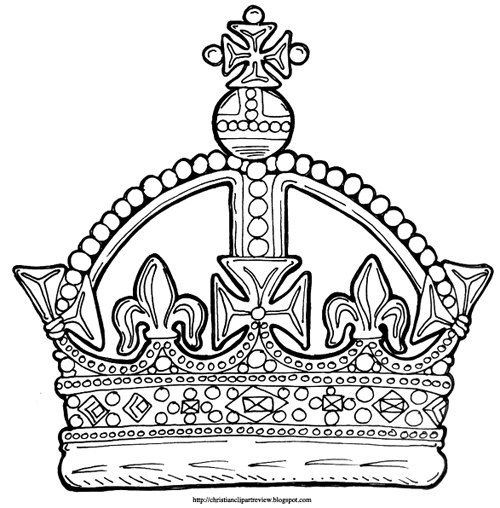
       The Crown, when on the head of the Madonna, in art, makes her the Queen of Heaven and Regina Angelorum. When the attribute of a martyr, it signifies the victory over sin and death, or denotes that the saint was of royal blood; in the latter case it is usually placed at the feet. Among the Jews the crown was the ornament of a bride, and to the present time it is placed on the head of a nun when consecrated as the Bride of Christ. For this reason it is more frequently seen on the heads of female saints, while those of the other sex hold it in the hand. It is sometimes a mere circlet, often a chaplet of flowers; and again it is magnificent with gold and precious jewels.
       The crown pattern above would suit nicely for either a embroidery design, or for coloring in metallic inks. Glue on a few faux gems or trace it onto tin with a dull pencil. Use your imagination!

Scriptural references for this Chrismon symbol:
  • "I am jealous for you with a godly jealousy. I promised you to one husband, to Christ, so that I might present you as a pure virgin to him." 2 Corinthians 11:2 (NIV)
  • "I am jealous for you with a godly jealousy. I promised you to one husband, to Christ, so that I might present you as a pure virgin to him. For a husband is the head of his wife as Christ is the head of the church. He is the Savior of his body, the church." Ephesians 5:22, 23 (NLT)
  • "Let us rejoice and exult and give him the glory, for the marriage of the Lamb has come, and his Bride has made herself ready; it was granted her to clothe herself with fine linen, bright and pure”— for the fine linen is the righteous deeds of the saints. Revelation 19:7,8 (ESV)
More About The Bride of Christ:
The crown with the additional 
scepter included is the 
''King Forever'' Symbol 
belonging only to Christ!

Wednesday, May 17, 2017

Canadian, Oh Canada! and Canada Titles


Description of Illustration: titles, three versions: Canadian, Oh Canada! and Canada, all have red maple leaves on white backgrounds


Have a question about the illustration? Just type it in the comment box and I'll get back to you as soon as possible. I only publish content that is closely related to the subject folks.

Bannières françaises patriotiques

Description of Illustration: 3 versions, French flag, banners come in red, white and blue variations, Patriotic French Banners

3 versions, drapeau français, les bannières viennent en rouge, blanc et bleu, bannières français patriotiques


Have a question about the illustration? Just type it in the comment box and I'll get back to you as soon as possible. I only publish content that is closely related to the subject, folks.

Vous avez une question sur l'illustration? Il suffit de le taper dans la boîte de commentaires et je vous rappellerai dès que possible. Je ne publie que du contenu qui est étroitement lié au sujet, les gens.

American Patriotic Clip Art Index

Clip art samples from my American Patriot Index.
All graphics/illustrations/clip art on this web journal are free to download and use for personal art projects, church related hard copy or webpages. Images are not to be redistributed in any other collections of clip art online. Please include a link back to this web journal if you use the materials for web articles. Link to http://christianclipartreview.blogspot.com
  1. For a Glorious Fourth Banner
  2. A Patriotic Flag Banner
  3. "Let Freedom Ring"
  4. Patriotic Bugle Banner
  5. Two American Eagles
  6. The drums of war...
  7. Vintage Uncle Sam Clipart
  8. Fireworks
  9. Election News Graphic Stars
  10. Safe and Sane Political Candidate?
  11. Pray For Peace
  12. American Flag and The Liberty Bell Graphics
  13. Bald Eagle with Scripture
  14. Died For Us
  15. Stuffed Star Banners (three versions)  
  16. Character Counts! 
  17. July 4th 1776 Postcard, (three versions)
  18. Vintage American Flag Illustration 
  19. "United We Stand" Top Hat
  20. Send a Vintage Salute for A Soldier's Birthday!  
  21. Uncle Sam Shield Frame
  22. Five Bucks for Every Crazy Question!
  23. "E Pluribus Unum"
  24. The Allies Never Forget!
United States Presidents:
  1. Portrait of Thomas Jefferson
  2. Illustration and Quote: Lincoln Memorial
  3. Pictures of Grover Cleveland
More Free, Patriotic Clip Art Collections:
Page last updated March 28th, 2022. 

Pictures of President Grover Cleveland

Portrait of President Cleveland, 22 president
of The United States.
Description of Illustration: portrait of Cleveland in greyscale and a drawing of his marriage to Frances Folsom in the white house in greyscale

Stephen Grover Cleveland (March 18, 1837 – June 24, 1908) was an American politician and lawyer who was the 22nd and 24th President of the United States. He won the popular vote for three presidential elections – in 1884, 1888, and 1892 – and was one of two Democrats (with Woodrow Wilson) to be elected president during the era of Republican political domination dating from 1861 to 1933. He was also the first and to date only President in American history to serve two non-consecutive terms in office. Read more...
Have a question about the illustration? Just type it in the comment box and I'll get back to you as soon as possible. I only publish content that is closely related to the subject folks.
On June 2, 1886, Cleveland married Frances Folsom in the Blue Room at the White House.

Portrait of Thomas Jefferson


President Thomas Jefferson 1801-1809
Description of Illustration: text, "Thomas Jefferson" medallion shaped portrait, black and white, powdered wig, ruffled collar

Thomas Jefferson (April 13 [O.S. April 2] 1743 – July 4, 1826) was an American Founding Father who was the principal author of the Declaration of Independence and later served as the third President of the United States from 1801 to 1809. Previously, he was elected the second Vice President of the United States, serving under John Adams from 1797 to 1801. A proponent of democracy, republicanism, and individual rights motivating American colonists to break from Great Britain and form a new nation, he produced formative documents and decisions at both the state and national level. He was a land owner and farmer. Read more...
Have a question about the illustration? Just type it in the comment box and I'll get back to you as soon as possible. I only publish content that is closely related to the subject folks.

July 4th 1776 Postcard, three versions

postcard, July 4th 1776, full color
Description of Illustration: text, "July 4th 1776" cannon, eagle, statue of liberty, three versions

postcard, July 4th 1776, red monochromatic
postcard, July 4th 1776, blue monochromatic
Have a question about the illustration? Just type it in the comment box and I'll get back to you as soon as possible. I only publish content that is closely related to the subject folks.

Character Counts!

David Rice
Description of Illustration: text, "Character Counts!", from my dad's old army days, transparent background
My dad, second man on the left, bottom row. Waiting with his army band, having coffee.
He played the clarinet, then gave it to a young boy in his home town who couldn't
afford one after he served his term as an officer in the army.


Have a question about the illustration? Just type it in the comment box and I'll get back to you as soon as possible. I only publish content that is closely related to the subject folks.

  The Andrew Sisters sing "Boogie Woogie Bugle Boy"
Before Dad's time but was still a popular tune even
in his day.

Stuffed Star Banner, three versions

red, white and blue
 Description of Illustration: stuffed, American flag stars, 3 versions: full color, blue and red only, white backgrounds, You may superimpose a text on these banners for advertising an event only, do not add quotes and redistribute them from web collections or web pages, folks.


blue monochromatic

red monochromatic
Have a question about the illustration? Just type it in the comment box and I'll get back to you as soon as possible. I only publish content that is closely related to the subject folks.

For a Glorious Fourth Banner

Description of Illustration: black and white, patriot, three cornered hat, drummer, drum and drum sticks, text "For a Glorious Fourth, stars and stripes on the text

Have a question about the illustration? Just type it in the comment box and I'll get back to you as soon as possible. I only publish content that is closely related to the subject folks.

A Partriotic Flag Banner

Description of Illustration:black and white, shield and flag, stars and stripes, banner

Have a question about the illustration? Just type it in the comment box and I'll get back to you as soon as possible. I only publish content that is closely related to the subject folks.

Saturday, May 13, 2017

The Gospel of Mark Clip Art Index

About: Dr. Lardner thinks that Mark's Gospel is alluded to by Clement of Rome: but the earliest ecclesiastical writer upon record who expressly mentions it is Papias. It is mentioned, also by Irenaeus, Clement of Alexandria, Tertullian, Origen, Eusebius, Epiphanius, Jerome, Augustine, Chrysostom, and many others.
Samples of clip art found in this Gospel of Mark Index.
All graphics/illustrations/clip art on this web journal are free to download and use for personal art projects, church related hard copy or webpages. Images are not to be redistributed in any other collections of clip art online. Please include a link back to this web journal if you use the materials for web articles. Link back to http://christianclipartreview.blogspot.com

Sometimes multiple scripture using the same image are uploaded onto the same page. Keep looking on the post and you will find that there is a scripture from the Book of The Bible it is listed under here.
  1. Get On Board The Church Bus! - Mark 16:15
  2. Church Interior with Scriptures - Mark 8:36
  3. Shofar and Scriptures - Mark 2:27
  4. "And the two shall become one..." Mark 10:8
  5. Camel Billboard - Mark 1:25
  6. Sleeping Through Stormy Seas - Mark 4:38
  7. The Black Sacred Heart Paired with Sacred Scripture - Mark 16:15
  8. Prutah or Widow's Mites - Mark 12:41
  9. The Widow's Offering or The Widow's Mite - Mark 12: 41-44
  10. Jesus warns against the teachers of the law - Mark 12: 37-40
  11. Mark 4:29 - forest
  12. Remember the faithful in South Africa - Mark 10:15
  13. Hosanna Palms - Mark 11:9
  14. Mark 11:9 - palm leaves up close
  15. Who is my brother? - Mark 3:35
  16. Illustrated and Illuminated Scripture for Lent - Mark 1:5
  17. How to Follow Jesus - Mark 8: 34-37
  18. Wedding Rings - Mark 10:7
  19. "And the two shall be one" - Mark 10:7
  20. Baptism of The Savior - Mark 1:9-13
  21. Loaves and Fish - story in Mark Chapter 6
  22. The Healing Christ - story in The Gospel of Mark, Chapter 5
  23. Mark 4:31-32 - mustard seed parable
  24. Remaining Faithful   - Mark 3:35
  25. Scriptures About Lepers  - Mark 1: 40-41 
  26. The Choir In Gold - Mark 14:26 
  27. "Son thy sins be forgiven thee..." Mark 2:5
  28. "Do this in remembrance of me."- Mark 14: 22-25
Questions and Answers About the Gospel of Mark:
video by The Bible Project

Page last updated on January 16th, 2022

Friday, May 12, 2017

A Prayer by Phoebe Cary

Prayer
by Phoebe Cary

Father! thou didst hear my prayer.
When I plead with thee to spare,
When I asked for length of years,
Thou didst pitying see my tears,
And thy words in answer were,
"Respite from the sepulchre!"
Lo! no more the prayer I raise:

Life hath waned to evil days;
Veiling in the dust my woes,
I would bless the grave's repose;
Sweeter, sweeter would it be,
Than a lover's dream to me.

Long enough thy child hath been
Struggling in a world of sin,
Long enough have doubts assailed,
Long enough the flesh prevailed,
Long enough hath sorrow tried
One it hath not purified.

In life's hours of rosy dawn,
Hope with white hand let me on,
Showing gorgeous imagery
Of a happier time to be;
But, in noonday's clearer flame,
Blest fruition never came.

Hastening now towards its close
Is the day that brightly rose,
And the hope that fled its prime
Comes not at evening time,
Hear me, pity, and recall,
Ere the midnight shadows fall!

Willing, eager to depart,
Old in years and old in heart,
Waiting but the messanger
To unseal the sepulchre,
Lo! again to Thee I come-
Take me, Father, take me home!