Friday, March 10, 2017

The Costume of a Jewish Priest


Description of the illustration: church elder, greyscale drawing, outreaching arms, open arms, giving and receiving

Kohen or cohen (or kohain; Hebrew: כֹּהֵן‎, "priest", pl. כֹּהֲנִיםkohanim) is the Hebrew word for priest used colloquially in reference to the Aaronic priesthood. Jewish kohanim are traditionally believed and halakhically required to be of direct patrilineal descent from the biblical Aaron. The term is colloquially used in Orthodox Judaism in reference to modern day descendants of Aharon, brother of Moses. Read more...

Have a question about the illustration? Just type it in the comment box and I'll get back to you as soon as possible. I only publish content that is closely related to the subject folks.
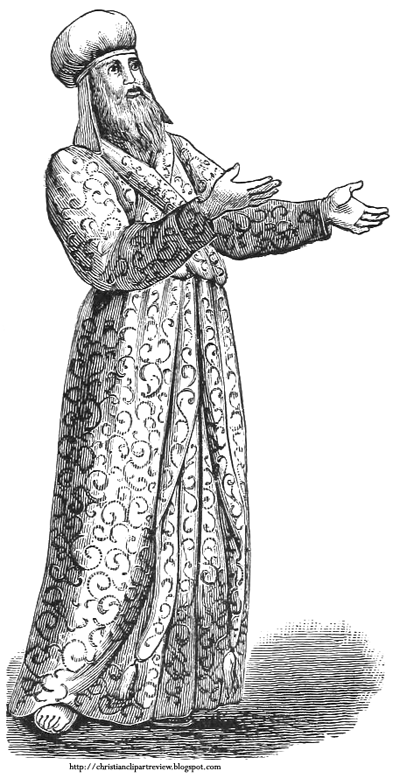
A drawing of a Jewish High Priest in Biblical times.

The Phylactery

Black and white phylactery.
Description of the illustration: black and white drawing,  The practice of using phylacteries was founded on a literal interpretaion of Ex.13:9,16; Deut. 6:8; 11:18, where God commands the Hebrews to bear the Law in their hearts and in their heads, and it is still continued in our days. There are two kinds of phylacteries - one to worn on the forehead, between the eyebrows, and another to be worn on the left arm. The former was called a "frontlet," and was composed of four pieces of parchment, on the first of which was written Ex. 12:2-10; on the second, Ex. 13: 11-21; on the third Deut. 6:4-9; and on the fourth, Deut. 11:18-21. These pieces of parchment, thus inscribed, were inclosed in a piece of tough skin, making a square, on one side of which was placed the Hebrew letter shin, and this box was tied to the forehead with a thong or riband. Some wore them both evening and morning, and others only at morning prayer. Dictionary of Bible

Have a question about the illustration? Just type it in the comment box and I'll get back to you as soon as possible. I only publish content that is closely related to the subject folks.

The Medieval Stars of David

Description of the illustration: Stars of David, Magen David, three versions in shades of blue and one of those combines blue and gold, transparent background
 
The Jewish Encyclopedia cites a 12th-century Karaite document as the earliest Jewish literary source to mention a symbol called "Magen Dawid" (without specifying its shape).

The name 'Shield of David' was used by at least the 11th century as a title of the God of Israel, independent of the use of the symbol. The phrase occurs independently as a Divine title in the Siddur, the traditional Jewish prayer book, where it poetically refers to the Divine protection of ancient King David and the anticipated restoration of his dynastic house, perhaps based on Psalm 18, which is attributed to David, and in which God is compared to a shield (v. 31 and v. 36). The term occurs at the end of the "Samkhaynu/Gladden us" blessing, which is recited after the reading of the Haftara portion on Saturday and holidays.

The earliest known text related to Judaism which mentions a sign called the "Shield of David" is Eshkol Ha-Kofer by the Karaite Judah Hadassi, in the mid-12th century CE:
Seven names of angels precede the mezuzah: Michael, Gabriel, etc. …Tetragrammaton protect you! And likewise the sign, called the "Shield of David", is placed beside the name of each angel.
This book is of Karaite, and not of Rabbinic Jewish origin, and it does not describe the shape of the sign in any way.
Have a question about the illustration? Just type it in the comment box and I'll get back to you as soon as possible. I only publish content that is closely related to the subject folks.

Thursday, March 9, 2017

"IHS" Plus a Crown Pattern for Chrismons

This particular pattern would look attractive as an embroidery.
      Crown. - A crown, in Christian art, is the symbol of sovereignty, victory, and of the glory of martyrdom. As the symbol of sovereignty, it is given to the Deity, and sometimes to the Virgin Mary. As the symbol of victory and the glory of martyrdom, it is given to saints and martyrs. In addition, it in some cases alludes to earthly rank. In this case it is a symbol for Christ's deity because it is paired with the Christogram beneath it.
       In the Latin-speaking Christianity of medieval Western Europe (and so among Catholics and many Protestants today), the most common Christogram became "IHS" or "IHC", denoting the first three letters of the Greek name of Jesus, IHΣΟΥΣ, iota-eta-sigma, or ΙΗΣ.

       The Greek letter iota is represented by I, and the eta by H, while the Greek letter sigma is either in its lunate form, represented by C, or its final form, represented by S. Because the Latin-alphabet letters I and J were not systematically distinguished until the 17th century, "JHS" and "JHC" are equivalent to "IHS" and "IHC".

by ChuckKnowsChurch

Leaping Lambs!

 
Description of the illustration: old engraving of sheep in a field, leaping lambs, pasture, black and white print, tails, grazing

Have a question about the illustration? Just type it in the comment box and I'll get back to you as soon as possible. I only publish content that is closely related to the subject folks.

St. Bernard Writing Commentaries

 
Description of the illustration: Roman Catholic Saint, French abbot, habits, reading, altar, Saints, Bible characters, black and white illustration, kneeling
 
Bernard was instrumental in re-emphasizing the importance of lectio divina and contemplation on Scripture within the Cistercian order. Bernard had observed that when lectio divina was neglected monasticism suffered. Bernard considered lectio divina and contemplation guided by the Holy Spirit the keys to nourishing Christian spirituality. Read more...

Have a question about the illustration? Just type it in the comment box and I'll get back to you as soon as possible. I only publish content that is closely related to the subject folks.

Saint Teresa of The Bare Footed Carmelites

Greyscale of St. Teresa illustration
Description of the illustration: Roman Catholic Saint, greyscale illustration, Spanish mystic, her father was a Messianic Jew, devotions of ecstasy, active reformer

The Discalced Carmelites are men and women, in religious consecration and lay people, who dedicate themselves to a life of prayer. The Carmelite nuns live in cloistered (enclosed) monasteries and follow a completely contemplative life. The Carmelite friars while following a contemplative life also engage in the promotion of spirituality through their retreat centres, parishes and churches. Lay people, known as the Secular Order, follow their contemplative call in their everyday activities. Devotion to the Virgin Mary is a characteristic of Carmelites and is symbolized by wearing the brown scapular. Read more...

Have a question about the illustration? Just type it in the comment box and I'll get back to you as soon as possible. I only publish content that is closely related to the subject folks.

Dove and Baptismal Font

 
Description of the illustration: old illustration of a baptismal font, descending dove, black and white drawing, found inside a Christian church, carved stone, christenings,

Have a question about the illustration? Just type it in the comment box and I'll get back to you as soon as possible. I only publish content that is closely related to the subject folks.

Illuminated Trinity

 
Description of the illustration: The Holy Trinity, illuminated text illustration, God the Father, God the Son, God the Holy Spirit in the form of a dove, cross, blessing hand, at their feet is the universe represented by the starry heavens, throne room of God, large floating crown, God the Father and God the Son look alike the scripture reference for this is "If you really know me, you will know my Father as well. From now on, you do know him and have seen him." John 14:7

Have a question about the illustration? Just type it in the comment box and I'll get back to you as soon as possible. I only publish content that is closely related to the subject folks.

Native American Pottery

 
Description of the illustration: blanket or shawl, native American woven textile, hand painted pottery, arts and crafts, monochromatic illustrations, 


Have a question about the illustration? Just type it in the comment box and I'll get back to you as soon as possible. I only publish content that is closely related to the subject folks.

Pink Cactus Flower

 
Description of the illustration: prickly, desert flower, petals, blooming in the desert, dirt, soil, 

Have a question about the illustration? Just type it in the comment box and I'll get back to you as soon as possible. I only publish content that is closely related to the subject folks.

Is linking to those who do not link back to me important?

       Yes it is, practice some generosity, it is a virtue. “It’s nice to be nice.” But, I am very particular about giving links within the context of a specific topic and I do visit the folks I link to, so I know if their content is spam or if it is misrepresenting the information it claims to be interested in.
       Keep all of your links sorted by topic or inside of the context of a article. This also will give you better ranking on the web.

Is it better to open a free blog software for my church than it is to create regular internet web pages?

       Yes, most of the time. This is a smart idea if your church has a tight budget, limited resources, and you only intend to publish information for the congregation to access alone. Blogs are perfect for this type of use. Also blogs, are user friendly software. You don’t need to rely upon the availability of a web designer in order to update your pages or remove them. You can do all of these functions yourself at little to no expense to your church. In fact, if you are a pastor or church secretary, we recommend that you become very familiar with blog software in your free time. This will give you an educational advantage should your church ever decide to conduct a ministry online. It will also help your congregation trim their budget expenses. One of the volunteer staff members here at our blog says that her church spends on average $5000 a year for it’s web site. I’ve seen this web site myself and it is absolutely “no big deal.” They could fall off the back side of a log and improve this baby. Blogs are pretty sweet these days. We are all in agreement on this one. Pastors and priests should run their own congregation’s web pages or hire office help to run a free blog until they have well established ministries that demand the attention of a staff.

Do the volunteers at your blog believe in salvation by works?

      No. We believe in Salvation by Grace alone through the shed blood of Jesus. We believe that “good works” when appropriate and pleasing to God, are done out of LOVE for God. Work that is proper and good is the result of the human heart being touched by the Holy Spirit and trained up to mirror the likeness of Christ. Works are the proper result of Grace already present within each believer. This is frequently called “Sanctification” in the Lutheran Church. Different Christians may call it by other terminology. But “a rose is still a rose by any other name.” Human works are necessary to the growing up of believers for the kingdom of God. We live here for a purpose and that purpose is to show Christ to others. We can not do this effectively without living out good actions, thoughts, and feelings. We work to aid humans and ourselves in this respect and to show love for God, not to earn salvation.
      Some people can appear to do a good deed without faith, but a person with faith will always be convicted by the Holy Spirit to do good, even when it does not benefit himself. If a man says that he is saved but then has no outward sign of change that is the result of his repentance, then he is probably lying about his true motives for claiming to be a Christian. God can determine whether or not a soul is willing to change for Him or if a person is simply lying in order to coexist with Christians for some other reason. This could be a difficult or easy thing for people to see clearly in others. There are people who successfully deceive many with their works but he or she cannot ultimately deceive God with incorrect agenda.
      One thing is for certain, that those who love God and are grateful will always display some form of good works. These works won’t always be what you or I may stereotypically call “works.” But we do not define works the same in every person and neither does God. Every part of the body of Christ has it’s own gifts and talents. Works look different for a pastor, doctor, lawyer, artist, musician, mother, chemist, police officer, rich man or poor man. Each gives back to others in his own way by the power of The Spirit and by the influences of Christ on his or her life through the study of the Holy Bible.

How often should I blog in order to have a "successful" blog?

      My answer to this question largely depends upon how many posts your blog already has and what type of content is in your blog to begin with.
      If you have a relatively medium sized blog of 65 to 100 posts, I recommend you update the blog within every 14 to 24 days. If your blog is over 300 posts, once a month is sufficient enough of an update. The fewer number of posts you have the more frequently you should make updates. Of course, none of this advice is necessary if you are keeping a blog for yourself, friends and family. Blogs are extremely personal for the majority of people and they need not conform to any demands of publishing as a rule, for those of you blogging for personal reasons.
      My opinions about numbers of posts are based upon statistics for ministry blogs alone. The successful ministry blog is measured by many varied pieces of information accumulated together. The number of posts is only one factor to take into consideration but it can be a very important one. Each post on a ministry blog, if possible, should number approximately 150 words. Each post should average four outside links and two internal page links.
       For those of you who read my blogs, you may have noticed that I do not always do this. But when giving professional advice to others, I try to speak to the truth of what I know to be the best advice possible for page ranking. There are certainly other web masters out there who are better bloggers than me and I know that these bloggers are meticulous about what to include in their posts.

Wednesday, March 8, 2017

Afrocentric Clip Art of The Virgin

  "Therefore the Lord himself will give you a sign: the virgin will conceive and give birth to a son, and will call him Immanuel." Isaiah 7:14

Description of the illustration: Mary mother of Jesus, Mary mother of God, baby Jesus, halos, rosy cheeks, blue gown, holding one another, tender love, Mary and her baby with scriptures from The Gospel of Luke and The Book of Romans, drawing of sculpture by Dupagne, from Congo (Central Africa)

       Mary (Greek: Μαρία María; Aramaic: ܡܪܝܡ‎, translit. Mariam‎; Hebrew: מִרְיָם‎,  Miriam‎; Arabic: مريم‎,  Mariam‎), also known by various titles, styles and honorifics, was a 1st-century Galilean Jewish woman of Nazareth and the mother of Jesus, according to the New Testament
      Mary resided in "her own house" in Nazareth in Galilee, possibly with her parents, and during her betrothal — the first stage of a Jewish marriage — the angel Gabriel announced to her that she was to be the mother of the promised Messiah by conceiving him through the Holy Spirit, and, after initially expressing incredulity at the announcement, she responded, "I am the handmaid of the Lord. Let it be done unto me according to your word." Joseph planned to quietly divorce her, but was told her conception was by the Holy Spirit in a dream by "an angel of the Lord"; the angel told him to not hesitate to take her as his wife, which Joseph did, thereby formally completing the wedding rites.
      Since the angel Gabriel had told Mary (according to Luke 1:36) that Elizabeth—having previously been barren—was then miraculously pregnant, Mary hurried to see Elizabeth, who was living with her husband Zechariah in "Hebron, in the hill country of Judah". Mary arrived at the house and greeted Elizabeth who called Mary "the mother of my Lord", and Mary spoke the words of praise that later became known as the Magnificat from her first word in the Latin version. After about three months, Mary returned to her own house.
       According to the Gospel of Luke, a decree of the Roman Emperor Augustus required that Joseph return to his hometown of Bethlehem to register for a Roman census. While he was there with Mary, she gave birth to Jesus; but because there was no place for them in the inn, she used a manger as a cradle. After eight days, he was circumcised according to Jewish law, and named "Jesus" (Hebrew: ישוע‎,  Yeshua‎), which means "Yahweh is salvation".
"For sin will have no dominion over you, since you are not
 under law but under grace..." Romans 6:14 (ESV)
"And Mary said, 'Behold, I am the servant of the Lord; let it be to
 me according to your word." And the angel departed from her." Luke 1:38 (ESV)
"As he said these things, a woman in the crowd raised her voice
 and said to him, 'Blessed is the womb that bore you, and the breasts at which you nursed!" (ESV)
Have a question about the illustration? Just type it in the comment box and I'll get back to you as soon as possible. I only publish content that is closely related to the subject folks.

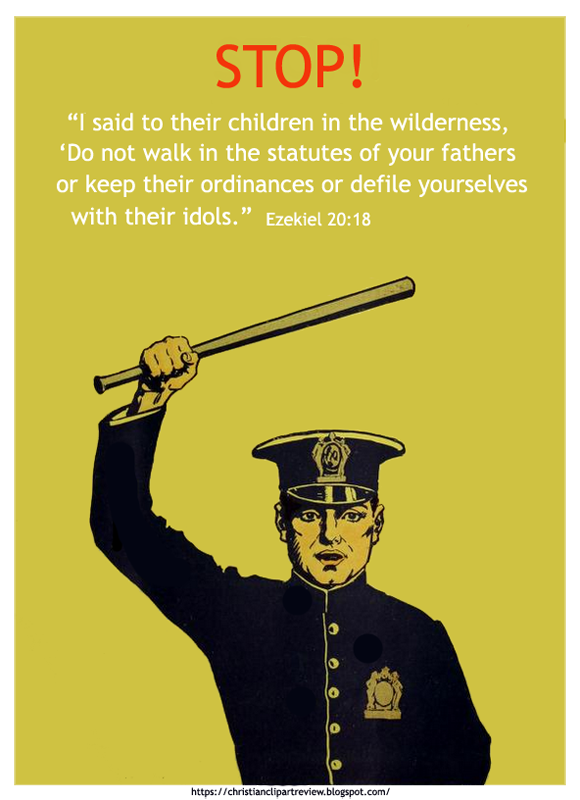
"Stop!" Ezekiel 20:18 clip art

STOP! "I said to their children in the wilderness, 'Do not
walk in the statutes of your fathers or keep their
ordinances or defile yourselves with their idols.
Description of the illustration: vintage police officer with a baton, bright yellow background, "STOP!" in red, scripture from Ezekiel, law enforcement, warnings from the scriptures

Cross Reference "Your children, however, whom you said would become a prey--
I will bring them in, and they will know the land which you
have rejected." Numbers 14:31 (NASB)
Have a question about the illustration? Just type it in the comment box and I'll get back to you as soon as possible. I only publish content that is closely related to the subject folks.

Who's Your Servant?

"Do your best to present yourself to God as one approved,
a worker who has no need to be ashamed,
rightly handling the word of truth." 2 Timothy 2:15 (ESV)
Description of the illustration: two people pictured, a man and a woman, speech bubble, scriptures from Philippians, Galatians and 2 Timothy, about servitude, servants, serving the Lord and The LORD serving us, bible in her lap, vintage photography
"... though he was in the form of God, did not count equality with God
 a thing to be grasped, but made himself nothing, taking the form of
 a servant, being born in the likeness of men."
Philippians 2:5-7 (ESV)
"For you were called to freedom, brothers. Only do not use
 your freedom as an opportunity for the flesh,
but through love serve one another."
 Galatians 5:13 (ESV)
Have a question about the illustration? Just type it in the comment box and I'll get back to you as soon as possible. I only publish content that is closely related to the subject folks.

Help, when least expected...

A Catholic monk and a Baptist preacher were walking
along a lonely dirt road together. What did they share
in common? You decide.
 "When I am afraid, I put my trust in you." 
Psalm 56:3

Description of the illustration:  Drawing by David Rice, Catholic monks, faces, habits, friends indeed, 

      This little drawing comes with an interesting story.
       As my parents aged they traveled quite a bit in Western Europe. It had always been their dream to travel after retirement. Dad was only given a brief window for this preoccupation; for he had been diagnosed with Parkinson's disease. 
       The following is the story as my mother often tells it. I think that it is true because it does seem like something my father would do:

      On one European tour in particular, Dad was still able to hobble about without much help so he and my mother decided to explore a little Italian village on a walk together alone. They wandered street to street, alley to alley and eventually they wandered down too many hidden streets and allies to know just where they were at. Of course, they had taken no map and couldn't speak a word of Italian. (If you knew my parents, you would not be in the least bit surprised by this kind of predicament.)
       So lost were they in fact that the only person remotely in their environment to happen along the same dirt road, was a humble monk. My father decided to ask for directions from the monk so that he and his wife might make it back to their tour bus before dark. Mother, was getting quite worried.
       First he asked the monk if he spoke any English. The monk indicated with a nod and a few hand gestures that he did not understand Dad. Then the monk asked Dad if he spoke Italian, at least that's what my mother thought, and Dad indicated that he did not. Then the monk asked Dad if he spoke German, at least that is what Dad thought. Dad said no, of course, but, he said no in English. Then the monk asked Dad if he spoke any French? Dad said no in English. Then the monk asked Dad if he spoke any Spanish. Dad said no in Spanish, however he didn't really speak any Spanish. 
       Then Mom began to look worried. Dad grinned quite mischievously and then asked the monk in perfect Latin if he spoke any Latin? The monk's face lit up and he laughed! Yes, he spoke fluent Latin. So Dad and his new friend spoke at length about being lost and in love with Italy. They talked about the sunset. They walked back through the village together, both while speaking a language that nobody else understood, arm in arm, much to my mother's relief!

Have a question about the illustration? Just type it in the comment box and I'll get back to you as soon as possible. I only publish content that is closely related to the subject folks.

In times of trial...

"So do not fear, for I am with you; do not be dismayed, for I am your God.
 I will strengthen you and help you; I will uphold you with my righteous
right hand." Isaiah 41:10 (NIV)
Description of the illustration: a man with raised hands, fear of being shot, fear of death, "stick 'em up", three scriptures: two from Isaiah and one from 2 Corinthians, transparent background
"No weapon forged against you will prevail, and you will refute every
tongue that accuses you. This is the heritage of the servants of the LORD,
 and this is their vindication from me," declares the LORD. 
Isaiah 54:17 (NIV)
"Indeed, we felt we had received the sentence of death.
But this happened that we might not rely on ourselves
 but on God, who raises the dead." 2 Corinthians 1:9
Have a question about the illustration? Just type it in the comment box and I'll get back to you as soon as possible. I only publish content that is closely related to the subject folks.

Tuesday, March 7, 2017

Get On Board The Church Bus!

“And He said to them, ‘Go into all the world and preach the gospel to every creature.'” Mark 16:15 (NIJV)
Description of the illustration:  Drawing by David Rice, church bus, church van, transportation, line drawing, children on board a bus or van, head lights, tail lights
Have a question about the illustration? Just type it in the comment box and I'll get back to you as soon as possible. I only publish content that is closely related to the subject folks.

The Discussion

The young and the old both take good council from God.
"Is not wisdom found among the aged? Does not long life bring understanding?" Job 12:12

Description of the illustration: two people talking together, large person, small person having a discussion, faces,   Drawing by David Rice

Have a question about the illustration? Just type it in the comment box and I'll get back to you as soon as possible. I only publish content that is closely related to the subject folks.

God's Good Wisdom:

Dad's river of smiles

"Finally, all of you, be like-minded, be sympathetic, love one another, be compassionate and humble." 1 Peter 3:8 (NIV)

Description of the illustration:abstract faces, facial features, teeth, eyes, noses, wave shapes, In Heaven there is a river of smiles.

Larger version for hardcopy, "River of Smiles" by David Rice.
Have a question about the illustration? Just type it in the comment box and I'll get back to you as soon as possible. I only publish content that is closely related to the subject folks.

 "I Smile" by Kirk Franklin

A little village...

A little village can have BIG faith.
"And let us consider how we may spur one another on toward love and good deeds, not giving up meeting together, as some are in the habit of doing, but encouraging one another—and all the more as you see the Day approaching." Hebrews 10: 24-25 (NIV)

Description of the illustration: houses, neighborhood, doors, windows, grass, turf, woods, trees, In this neighborhood there is God's peace. He can make a home in your heart, if you let him. Drawing by David Rice

Have a question about the illustration? Just type it in the comment box and I'll get back to you as soon as possible. I only publish content that is closely related to the subject folks.

"It takes a whole village to raise a child"

"O For the Wings of a Dove" Banner by Kathy Grimm

Make a banner like the one above to celebrate your child's
Baptism or Confirmation.
       A different, fun approach to making a baptismal banner; I used No-Sew to create the banner you see here. But first you will need to cut a white canvas banner to the size you need. Turn under the raw edges and finish them off before you begin your banner. Add a pocket at the top of the banner for a dowel so that the banner may be easy to hang when it is completed.
       Draw a dove onto the cotton background with a soft led pencil prior the bonding the fabrics with your iron also. Avoid filling in the dove with No-Sew scraps until after you have sewn on lace by hand at the end of the project.
       Collect a wide range of blues, greys, and lavender calico. Apply the No-Sew to the backside of the fabrics (follow instructions on package) before cutting long stripes. Then chop up the strips and heat up the iron! Now you are ready to iron the shredded fabrics onto a heavy cotton banner. Make sure to alternate the fabrics
       After you have finished the background of water and sky as you see it in the photo, cut out lace and orange/white fabrics for the dove and halo. I applied the lace for feathers of the dove by hand, using a thread and needle.
       Don't forget to iron a bit of orange fabric onto the water to emphasize the reflection of the dove's halo. The addition of blue's compliment, orange, will make the colors vibrate against one another when viewed at a distance!

See a smaller part of the banner close-up.

"O For the Wings of a Dove" by George
Gensac, France

Etrog clip art for Sukkot

In the Chassidic community, some Jews pickle or candy the etrog (citron) from Sukkot and eat it on Tu BiShvat. Some pray that they will be worthy of a beautiful etrog on the following Sukkot.
Description of Illustration: two versions of the same illustration one in monochromatic yellow shades the other in green and yellow, etrog fruit
      Rabbinic Judaism believes the Biblical phrase peri eitz hadar (פְּרִי עֵץ הָדָר) refers to the etrog. Grammatically, the Hebrew phrase is ambiguous; it is typically translated as "fruit of a beautiful tree," but it can also be read as "a beautiful fruit of a tree." Etrogs are carefully selected for the performance of the Sukkot holiday rituals.       
      In modern Hebrew, hadar refers to the genus Citrus. Nahmanides (1194 – c. 1270) suggests that the word was the original Hebrew name for the citron. According to him, the word etrog was introduced over time, adapted from the Aramaic. The Arabic name for the citron fruit, itranj (اترنج), mentioned in hadith literature, is also associated with the Hebrew. A hadar in Greek is hydro, which means it needs a lot of water. The hydro tree needs a lot of water and a etrog needs a lot of water.
 Have a question about the illustration? Just type it in the comment box and I'll get back to you as soon as possible. I only publish content that is closely related to the subject folks.

Fruits for Celebrating Tu BiShvat

"When you lay siege to a city for a long time, fighting against it in order to capture it you must not destroy its trees by putting ax to them, because you can get food from them. You must not cut them down. Are trees of the field human, to come under siege by you? Deuteronomy 20:19
Description of Illustration: illustrations of olive, grapes and figs for Jewish holidays, full color, some have transparent backgrounds, text "Deuteronomy 20:19

In the Middle Ages, Tu BiShvat was celebrated with a feast of fruits in keeping with the Mishnaic description of the holiday as a "New Year." In the 16th century, the kabbalist Rabbi Yitzchak Luria of Safed and his disciples instituted a Tu BiShvat seder in which the fruits and trees of the Land of Israel were given symbolic meaning. The main idea was that eating ten specific fruits and drinking four cups of wine in a specific order while reciting the appropriate blessings would bring human beings, and the world, closer to spiritual perfection.

Plate of ripe, red grapes
Collection of figs
Have a question about the illustration? Just type it in the comment box and I'll get back to you as soon as possible. I only publish content that is closely related to the subject folks.
A Cross Confirmation Banner by Kathy Grimm

Close-up of the Cross Confirmation Banner.
      Within Christianity, confirmation is seen as the sealing of the covenant made in Holy Baptism. In some denominations, confirmation also bestows full membership in a local congregation upon the recipient. In others, such as the Roman Catholic Church, confirmation “renders the bond with the Church more perfect,” because a baptized person is already a full member.
      In Protestant churches, the rite tends to be seen rather as a mature statement of faith by an already baptized person. It is also required by most Protestant denominations for membership in the respective church, in particular for traditional Protestant churches. In these traditional Protestant churches: Episcopal, Presbyterian, Methodist, Lutheran it is recognized by a coming of age ceremony.
      I have designed a simple banner that may be used during a Confirmation ceremony. The cross applique pattern is included below for those of you who would like to sew your own version. This design may be made by either traditional appliqué methods or by backing fabrics with a fusible material during the cutting, pressing and assembling of the banner.
Traditional reds and whites are used for this Confirmation banner.
I even selected a bit of iridescent white fabric to jazz it up a bit.
Confirmation cross pattern for the banner by Kathy Grimm
Latin variety of The Cross Patonce, often used for making
Chrismon Christmas ornaments.
Scripture References for The Confirmation Cross Symbol:
  • "In him you also, when you heard the word of truth, the gospel of your salvation, and believed in him, were sealed with the promised Holy Spirit," Ephesians 1:13 (ESV)
  • "Every word of God proves true; he is a shield to those who take refuge in him." Proverbs 30:5 (ESV)
  • "Have I not commanded you? Be strong and courageous. Do not be frightened, and do not be dismayed, for the Lord your God is with you wherever you go.” Joshua 1:9 (ESV)
  • "And it is God who establishes us with you in Christ, and has anointed us, and who has also put his seal on us and given us his Spirit in our hearts as a guarantee." 2 Corinthians 1:21-22 (ESV)

Monday, March 6, 2017

One Church Many Ministries Banner by Lois Prahlow

"One Church Many Ministries Banner" by Lois Prahlow. Png. not for republishing
“The Lord God planted a garden in Eden and watered it with the crystal river of the water of life flowing from the throne of God and the Lamb through the middle of the street of the city. You are that garden rooted in His love, spreading His fragrance.”

       This colorful banner celebrates the variety of ministries in which the baptized Church engages in grateful response to God for the salvation they have received in Jesus Christ, the Lamb who was slain for them. It draws from and combines imagery in Genesis 2:8ff, John 4:7ff, Matthew 28:16-20, II Corinthians 2:14, Ephesians 3:14-19, and Revelations 22:1-5.
       In the waters of Baptism and by His Word, the Church is united with Jesus Christ in His death and resurrection. They are planted by God like flower in a garden, and are watered with pure, life-giving crystal water, untainted by sin or death. They are empowered by the Holy Spirit and filled with the water of life flowing from the rainbow-encircled throne of God and the Lamb. Filled with love and the joy of salvation in Christ Jesus, their Lord, they go into the world, the street of the city, and there let the living water flow through them in service to God and mankind whom He wants to save. They draw sustenance from His love in which they are rooted, and they spread the fragrance and knowledge of Christ wherever they go. article and design by Lois Prahlow.

Free Standing Cirular Banner Stand by Lois Prahlow

Designed by Lois Prahlow
Free Standing Circular Banner Stand.
  1. Start with a six foot felt banner.
  2. Half-circle of felt stitched to back of banner 1/4″ from edge of circle
  3. Corrugated plastic is available in 4×8 sheets from sign companies. Cut with x-acto tool.
  4. Insert should be cut 1/2″ less than felt circle
  5. Slots into which Velcro strips are inserted to secure pole to corrugated plastic. Push pins should be pressed through each Velcro piece into wood to prevent slippage.
  6. Corrugated plastic insert, after attachment to pole, is slipped into the loose-bottomed pocket on the back of the banner.
  7. Metal plate and pipe, diameter slightly larger than that of the pole, welded to wheel base. Discarded automobile wheel from junk yard.