Thursday, June 15, 2017

The Fish Symbol or ICHTHYS

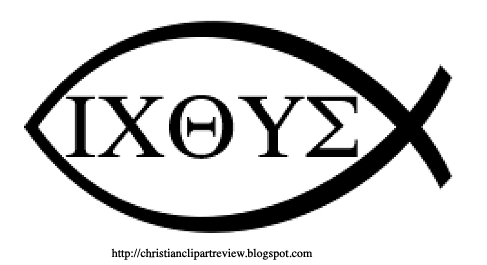
       The ichthys or ichthus (/ˈɪkθəs/), from the Greek ikhthýs (ἰχθύς 1st cent. AD Koine Greek [ikʰˈtʰys], "fish") is a symbol consisting of two intersecting arcs, the ends of the right side extending beyond the meeting point so as to resemble the profile of a fish. Now known colloquially as the "sign of the fish" or the "Jesus fish". 
       According to tradition, ancient Christians, during their persecution by the Roman Empire in the first few centuries after Christ, used the fish symbol to mark meeting places and tombs, or to distinguish friends from foes:
"According to one ancient story, when a Christian met a stranger in the road, the Christian sometimes drew one arc of the simple fish outline in the dirt. If the stranger drew the other arc, both believers knew they were in good company. Current bumper-sticker and business-card uses of the fish hearken back to this practice."

— Christianity Today, Elesha Coffman, "Ask The Expert"
       There are several other hypotheses as to why the fish was chosen. Some sources indicate that the earliest literary references came from the recommendation of Clement of Alexandria to his readers (Paedagogus, III, xi) to engrave their seals with the dove or fish. However, it can be inferred from Roman monumental sources such as the Cappella Greca and the Sacrament Chapels of the catacomb of St. Callistus that the fish symbol was known to Christians much earlier. Another probable explanation is that it is a reference to the scripture in which Jesus miraculously feeds 5,000 people with fish and bread Matthew 14:15-21, Mark 6:30-44, Luke 9:12-17, and John 6:4-13). The ichthys may also relate to Jesus or his disciples as "fishers of men" (e.g., Mark 1:17). Tertullian, in his treatise On Baptism, makes a pun on the word, writing that "we, little fishes, after the example of our ΙΧΘΥΣ Jesus Christ, are born in water." Still another explanation could be the reference to the sign of Jonah. Just like he was in the belly of a big fish, so Christ was crucified, entombed for three days, and then rose from the dead.
The ICHTHYS with lettering.

ΙΧΘΥΣ, or also ΙΧΘΥϹ with lunate sigma (Ichthys) is a backronym/acrostic for "ησοῦς Χριστός, Θεοῦ Υἱός, Σωτήρ", (Iēsous Christos, Theou Yios, Sōtēr) contemporary Koine [ie̝ˈsus kʰrisˈtos tʰeˈu (h)yˈjos soˈte̝r], which translates into English as "Jesus Christ, Son of God, Saviour."
  • Iota (i) is the first letter of Iēsous (Ἰησοῦς), Greek for "Jesus".
  • Chi (ch) is the first letter of Christos (Χριστός), Greek for "anointed."
  • Theta (th) is the first letter of Theou (Θεοῦ), Greek for "God's", the genitive case of Θεóς, Theos," Greek for "God."
  • Upsilon (y) is the first letter of (h)yios (Υἱός), Greek for "Son".
  • Sigma (s) is the first letter of sōtēr (Σωτήρ), Greek for "Savior."
       This explanation is given among others by Augustine in his Civitate Dei, where he notes that the generating sentence " Ἰησοῦς Χριστὸς [sic] Θεοῦ Υἱὸς Σωτήρ" has 27 letters, i.e. 3 x 3 x 3, which in that age indicated power. (This suggestion is obviously spurious, resulting from Augustine's ignorance of Greek.) Augustine quotes also an ancient text from the Sibylline oracles whose verses are an acrostic of the generating sentence.
       A fourth century A.D. adaptation of ichthys as a wheel contains the letters ΙΧΘΥΣ superimposed such that the result resembles an eight-spoked wheel.
Scripture References for ICHTHYS Chrismons:
  • "Jesus called out to them, "Come, follow me, and I will show you how to fish for people!" Mark 1:17 (NLT)
  • "Then some of the scribes and Pharisees answered him, saying "Teacher, we wish to see a sign from You." And answering He said to them, "An evil and adulterous generation seeks for a sign, and no sign will be given to it, except the sign of Jonah the prophet. For just as Jonah was in the belly of the great fish three days and three nights, so the Son of Man will be in the heart of the earth three days and three nights. The men of Nineveh will stand up in the judgment with this generation and will condemn it." Matthew 12: 38-42 (BLB)
  • "You killed the author of life, but God raised him from the dead. We are witnesses of this." Acts 3:15 (NIV)
The fish with realistic dimension. 

Wednesday, June 14, 2017

An Inhabited Cross Chrismon

Inhabited Cross, Florentine, 1491. All inhabited crosses have one of the
following depicted on them: people, animals and/or villages/cities.
Inhabited crosses look different depending on the culture of the artist
who designs the cross. The above is one of many types.
       The inhabited cross is an ancient variety of this symbol, described by Dante in his Divina Commedia, printed in Florence in 1491. This cross is resplendent with a glory far more radiant then the suns and constellations of every kind which blaze around it. Arriving with Beatrice in the planet Mars, the poet exlaims:
"For with so great a lustre and so red
Splendors appeared tome in twofold rays,
I said: "O Helios who dost so adorn them!"
Even as distinct with less and greater lights
Glimmers between the two poles of the world
The Galaxy that maketh wise men doubt,
Thus constelled in the depths of Mars,
Those rays described the venerable sign
That quadrants joining in a circle make.
Here doth my memory overcome my genius;
For on that cross as levin gleamed forth Christ,
So that I cannot find ensample worthy:
But he who takes his cross and follows Christ,
Again will pardon me what I omit,
Seeing in that aurora lighten Christ.
From horn to horn, and 'twixt the top and base,
Lights were in motion, brightly scintillating
As they together met and passed each other"

       Among the twelve little figures inhabiting the cross, representing the souls of valiant warriors, Dante gives the names of eight who occupy the arms of the cross, beginning from left to right. These are Joshua, Judas Maccabaeus, Charlemagne, and Roland in the left arm; and the right, William the Conqueror, Richard Coeur de Lion, Godfrey de Bouillon, and Robert Guiscard. Cacciaguida, and ancestor of the poet, is one of the four souls, not named, who are kneeling in the stem, and upper part of the cross. 

"This cross does not contain the Crucified in person, and yet Dante declares that there Christ shone resplendent; in fact, as has been said, the Cross is the symbol of Christ. Iconographically considered, the Son of God is in the Cross, as He is in the Lamb, and in the Lion; He is there hidden under the semblance of the instrument of punishment on which He died. The second Person of the Trinity is figured by an infinite number of different objects: three alone, the Lamb, the Lion, and the Cross, are symbols of our Lord. Even the Fish does not rise to the dignity of a divine symbol." (Didron, Christ. Ion., vol. i., p. 405.)

Scriptural References for Any Inhabited Cross Chrismon:
  • "Great is the LORD, and greatly to be praised, In the city of our God, His holy mountain. Beautiful in elevation, the joy of the whole earth, Is Mount Zion in the far north, The city of the great King. God, in her palaces, Has made Himself known as a stronghold." Psalm 48:1-3
  • "And I saw the holy city, new Jerusalem, coming down out of heaven from God, made ready as a bride adorned for her husband." Revelation 21:2
  • "But as it is, they desire a better country, that is, a heavenly one Therefore God is not ashamed to be called their God; for He has prepared a city for them." Hebrews 11:16

Lamp Symbolism for Chrismons

An ancient Christian oil lamp with the initials of
 Christ (Chi-Rho) and two fish sculpted on it's surface.
         An oil lamp is an object used to produce light continuously for a period of time using an oil-based fuel source. The use of oil lamps began thousands of years ago and continues to this day, although not commonly anymore. Here there are two ancient oil lamp illustrations that you may use for Chrismon patterns. They are actual drawings of early Christian lamps.
       Early oil lamps were often used by Christians to symbolize the wisdom, enlightenment and spiritual knowledge gained by exposure to Christ's teaching.
This ancient lamp depicts a shepherd with a lamb over his shoulders
 and grapes surrounding the vignette. Both are examples of early
Christian art in Rome.

Antique bronze oil lamp with the "Chi Rho",
a Christian symbol (replica)
Scripture References for Lamp Chrismons:
  • "Thy word is a lamp to my feet, And a light to my path." Psalm 119:105 (NASB)
  • "the people who sat in darkness saw a great light, to those who sat in the region and shadow of death, to them light has dawned." Matthew 4:16 (WEB)
  • "Then Jesus spoke out again, "I am the light of the world. The one who follows me will never walk in darkness, but will have the light of life." John 8:12 (NET Bible)
  • "Wherefore he saith, Awake thou that sleepest, and arise from the dead, and Christ shall give thee light.
    "
    Ephesians 5:14 (KJB)
  • "And I have seen that wisdom excels folly as far as light excels darkness." Ecclesiastes 2:13 (Jubilee Bible 2000)
Amy Grant's song "Thy Word" is 
based upon Psalm 119:105 text.

Tuesday, June 13, 2017

The Savior's Anchor Symbol

       As the Greek word for a fish, ΙΧΘΥΣ, contained the initials of the name and titles of Christ, "Ἰησοῦς Χριστός, Θεοῦ Υἱός, Σωτήρ", Jesus Christ the Son of God, the Savior, the figure of a fish was one of the earliest Christian symbols.

Scripture References for The Savior's Anchor Chrismon:
  • "But soon a fierce storm came up. High waves were breaking into the boat, and it began to fill with water. Jesus was sleeping at the back of the boat with his head on a cushion. The disciples woke him up, shouting, "Teacher, don't you care that we're going to drown?" When Jesus woke up, he rebuked the wind and said to the waves, "Silence! Be still!" Suddenly the wind stopped, and there was a great calm. Then he asked them, "Why are you afraid? Do you still have no faith?" The disciples were absolutely terrified. "Who is this man?" they asked each other. "Even the wind and waves obey him!" Mark 4:37-41(NLT)
  • "Where is your faith?" He asked. Frightened and amazed, they asked one another, "Who is this? He commands even the winds and the water, and they obey Him!" Luke 8:25 (BSB)
  • "And the LORD, he it is that doth go before thee; he will be with thee, he will not fail thee, neither forsake thee: fear not, neither be dismayed." Deuteronomy 31:8 (KJB)
Anchor of the soul in medallion.

The Divine Hand of Christ Chrismon

       The Divine Hand of Christ or The Divine Hand of Jesus rests on a Cruciform Nimbus. He is giving the blessing holding up two fingers which is symbolic for The Second Person of The Holy Trinity. This particular Chrismon or Christian Symbol comes from an Italian sculpture of the XII century: in the porch of the Cathedral of Ferrara.

Scriptural References for the Divine Hand of Christ Chrismon:
  • "Praise the God and Father of our Lord Jesus Christ, who has blessed us in Christ with every spiritual blessing in the heavens." Ephesians 1:3 (HCSB)
  • "He'll love you and increase your numbers. He'll bless the fruit of your womb, the fruit of your land (the grain, new wine, and oil), the offspring of your herds, and the lambs of your flock, in the land that the LORD promised your ancestors he would give you." Deuteronomy 7:13 (ISV)
  • "The LORD bless thee, and keep thee: The LORD make his face shine upon thee, and be gracious unto thee: The LORD lift up his countenance upon thee, and give thee peace." Numbers 6: 24-26 (KJB)
  • ""Bring the whole tithe into the storehouse, so that there may be food in My house, and test Me now in this," says the LORD of hosts, "if I will not open for you the windows of heaven and pour out for you a blessing until it overflows." Malachi 3:10 (NASB)
Latin Form - Hand of God

The Cross of Glory Chrismon

      The Cross of Glory chrismon/symbol is always depicted with precious stones or gems and some kind of floral motif.

Scriptural References for The Cross of Glory Chrismon:
  • "But now the righteousness of God without the law is manifested, being witnessed by the law and the prophets; Even the righteousness of God which is by faith of Jesus Christ unto all and upon all them that believe: for there is no difference: For all have sinned, and come short of the glory of God; Being justified freely by his grace through the redemption that is in Christ Jesus: Whom God hath set forth to be a propitiation through faith in his blood, to declare his righteousness for the remission of sins that are past, through the forbearance of God;To declare, I say, at this time his righteousness: that he might be just, and the justifier of him which believeth in Jesus." Romans 3:21-26 (KJB)
  • "Jesus saith unto her, Said I not unto thee, that, if thou wouldest believe, thou shouldest see the glory of God?" John 11:40 (KJB)
  • "And the Word became flesh and dwelt among us, and we have seen his glory, glory as of the only Son from the Father, full of grace and truth." John 1:14 (ESV)
  • "Christ is the visible image of the invisible God. He existed before anything was created and is supreme over all creation, for through him God created everything in the heavenly realms and on earth. He made the things we can see and the things we can't see--such as thrones, kingdoms, rulers, and authorities in the unseen world. Everything was created through him and for him." Colossians 1:15-16 (NLT)

The Crown of Martyrdom

       The Palm, in Christian art, is the symbol of martyrdom when combined with a crown. It is often found on the tombs of the early martyrs, and belongs to any saint who has suffered death in the cause of Christ. These saints are known to God the Father even if we do not know who they are. There have been many peoples around the world who have suffered this kind of death.

2nd example of the same crown of the martyrs.
Scriptural References for The Crown of Martyrdom:
  • "When the Lamb broke the fifth seal, I saw underneath the altar the souls of those who had been slain because of the word of God, and because of the testimony which they had maintained;" Revelation 6:9 (NASB)
  • "They were stoned, they were sawn in two, they were tempted, they were put to death with the sword; they went about in sheepskins, in goatskins, being destitute, afflicted, ill-treated..." Hebrews 11:37 (NASB)
  • "so that the blood of all the prophets, shed since the foundation of the world, may be charged against this generation, from the blood of Abel to the blood of Zechariah, who was killed between the altar and the house of God; yes, I tell you, it shall be charged against this generation.'' Luke 11: 50-51 (NASB)
  • "'Do not fear what you are about to suffer. Behold, the devil is about to cast some of you into prison, so that you will be tested, and you will have tribulation for ten days Be faithful until death, and I will give you the crown of life." Revelation 2:10 (NASB)
  • ""They will make you outcasts from the synagogue, but an hour is coming for everyone who kills you to think that he is offering service to God." John 16:2 (NASB)
  • ""Then they will deliver you to tribulation, and will kill you, and you will be hated by all nations because of My name." Matthew 24:9 (NASB)
  • "Blessed is the man who remains steadfast under trial, for when he has stood the test he will receive the crown of life, which God has promised to those who love him." James 1:12 (ESV)

The Virgin Holding Baby Jesus Chrismon

Mary is pictured: seated on a throne that is carved like a church, on her lap is the baby Jesus, on her head is a crown of honor for her sacrifices, she is handing to Jesus a piece of fruit that is symbolic for the tree of knowledge. This symbolism refers to the task that Jesus must accomplish: to replace Adam, Romans 5: 12-21.
The Scripture Reference for the Christian Chrismon Above:
  • "Therefore, just as sin came into the world through one man, and death through sin, and so death spread to all men because all sinned—for sin indeed was in the world before the law was given, but sin is not counted where there is no law. Yet death reigned from Adam to Moses, even over those whose sinning was not like the transgression of Adam, who was a type of the one who was to come. But the free gift is not like the trespass. For if many died through one man’s trespass, much more have the grace of God and the free gift by the grace of that one man Jesus Christ abounded for many. And the free gift is not like the result of that one man’s sin. For the judgment following one trespass brought condemnation, but the free gift following many trespasses brought justification. For if, because of one man’s trespass, death reigned through that one man, much more will those who receive the abundance of grace and the free gift of righteousness reign in life through the one man Jesus Christ. Therefore, as one trespass led to condemnation for all men, so one act of righteousness leads to justification and life for all men. For as by the one man’s disobedience the many were made sinners, so by the one man’s obedience the many will be made righteous. Now the law came in to increase the trespass, but where sin increased, grace abounded all the more, so that, as sin reigned in death, grace also might reign through righteousness leading to eternal life through Jesus Christ our Lord." Romans 5:12-21 (ESV)
More Scriptural Resources for Crown Images in Chrismons:

A Crown, in Christian art, is the symbol of sovereignty, victory, and of the glory of martyrdom. It is assigned in five instances. The scripture that you teach and/or include along with that Chrismon is dictated by it's visual or traditional representation:
  1. It is given to Deity, to Jesus who is the only one who has paid the blood sacrifice for the sin of mankind and who is also the second person of The Holy Trinity. "God presented Christ as a sacrifice of atonement, through the shedding of his blood--to be received by faith. He did this to demonstrate his righteousness, because in his forbearance he had left the sins committed beforehand unpunished--he did it to demonstrate his righteousness at the present time, so as to be just and the one who justifies those who have faith in Jesus." Romans 3:26 (NIV)
  2. Traditionally the Catholic church has also assigned a crown to Mary because she bore Jesus into the world against the enemies of the air and she was also was one of the first woman to receive the outpouring of the Holy Spirit at Pentecost. She is ranked high with the 12 apostles. "She gave birth to a son who was to rule all nations with an iron rod. And her child was snatched away from the dragon and was caught up to God and to his throne." Revelation 12:5 and "When they arrived, they went upstairs to the room where they were staying. Those present were Peter, John, James and Andrew; Philip and Thomas, Bartholomew and Matthew; James son of Alphaeus and Simon the Zealot, and Judas son of James. They all joined together constantly in prayer, along with the women and Mary the mother of Jesus, and with his brothers." Acts 1:13-14 (NIV)
  3. As the symbol of victory and the glory of martyrdom, it is given to saints and martyrs that have been canonized by Christian Orthodox Churches.
  4. Crowns are also assigned to all people who believe on the basis of their faith as described in Revelations, this being the traditional perspective held by Protestant Christendom. These people toss their crowns at the feet of King Jesus in the end times. "the twenty-four elders fall down before him who is seated on the throne and worship him who lives forever and ever. They cast their crowns before the throne, saying“Worthy are you, our Lord and God, to receive glory and honor and power, for you created all things, and by your will they existed and were created.” Revelation 4: 10-11 (gotquestions.org)
  5. And lastly, crown symbols are assigned to ruling monarchs on Earth.

The Descending Dove or Divine Dove Symbol

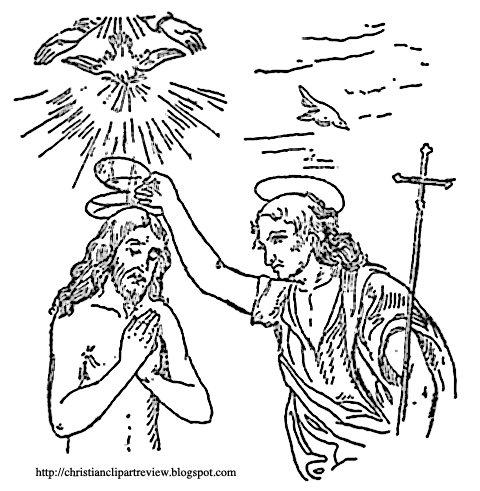
       The Holy Ghost, the dove appears in most of the early representations of scenes in Christ's life-- most frequently, perhaps, in pictures of his baptism, literally rendering the words from the Gospel of John "I saw the Spirit descending from heaven like a dove." Chapter 1:32
This Divine Dove, in a radiating aureole is from a French Miniature.
  

Dove typifying grace of the Holy Spirit descending upon Christ
in his baptism. (From a painting, "Baptism of Verrocchio," in
 Florence.)
Scriptural Reference for The Descending Dove Chrismon:
  • "As soon as Jesus was baptized, he went up out of the water. At that moment heaven was opened, and he saw the Spirit of God descending like a dove and alighting on him." Matthew 3:16 (NIV)
  • "For we were all baptized by one Spirit so as to form one body--whether Jews or Gentiles, slave or free--and we were all given the one Spirit to drink. "1 Corinthians 12:13 (NIV)
  • "What are you waiting for? Get up and be baptized. Have your sins washed away by calling on the name of the Lord.' Acts 22:16 (NLT)
  • "For as many of you as were baptized into Christ have put on Christ."  Galatians 3:27 (ESV)

Saturday, June 10, 2017

Combined Triangle, Trinitarian, Dove Symbol - Many Trefoils

This trefoil shape also includes a descending dove; a reference to Christ's Baptism.
       Trefoil (from Latin trifolium, "three-leaved plant", French trèfle, Italian trifoglio, German Dreiblatt and Dreiblattbogen, Dutch klaver, "clover", same as clubs) is a graphic form composed of the outline of three overlapping rings used in architecture and Christian symbolism. The term is also applied to other symbols of three-fold shape.
       Trefoil is a term in Gothic architecture given to the ornamental
foliation or cusping introduced in the heads of window lights,  tracery,
 panellings, etc., in which the center takes the form of a three-lobed leaf
(formed from three partially overlapping circles). One of the earliest
examples is in the plate tracery at Winchester (1222–1235). The fourfold
 version of an architectural trefoil is a quatrefoil.
       A simple trefoil shape in itself can be symbolic of the Trinity,
 while a trefoil combined with an equilateral triangle was also
 a moderately common symbol of the Christian Trinity
during the late Middle Ages in some parts of Europe.

Scripture Reference for The Trinity Symbol With Dove:
  • "But the Helper, the Holy Spirit, whom the Father will send in my name, he will teach you all things and bring to your remembrance all that I have said to you."John 14:26 (ESV)
  • "Peace I leave with you; my peace I give you. I do not give to you as the world gives. Do not let your hearts be troubled and do not be afraid." John 14:27 (NIV)
Above and below, more Trefoil Triangle verions.


The Open Bible Chrismon

I've posted a simple interpretation of this Chrismon here.
 
       The Open Bible symbol reminds us all that God's word should always be made available to everyone and that it should be free for all to study, contemplate and share.

Scriptural Reference for the Open Bible Chrismon:
  • "Then Jesus came to Nazareth, where He had been brought up. As was His custom, He entered the synagogue on the Sabbath. And when He stood up to read, the scroll of the prophet Isaiah was handed to Him. Unrolling it, He found the place where it was written: "The Spirit of the Lord is on Me, because He has anointed Me to preach good news to the poor. He has sent Me to proclaim deliverance to the captives and recovery of sight to the blind, to release the oppressed, to proclaim the year of the Lord's favor."Luke 4:16 (Berean Study Bible)
The open Bible suspended in the clouds with cross.


The open Bible with a dove symbol above it.

Babe In The Manger Symbol

       The baby in the manger serves to remind us of how Jesus first came to earth, fragile and small, through humble beginnings.
       Little Jesus was descended from the house of David, Malkhut Beit David (מלכות בית דוד) – "Kingdom of the House of David" Both Joseph and Mary were from this same house.
       The Holy Babe was also born of a virgin; he was conceived in the womb of his mother Mary through the Holy Spirit without the agency of a human father and born while Mary was still a virgin. The New Testament references are Matthew 1:18-25, Luke 1:26-38 and Isaiah 7:14.
       He was wrapped in swaddling an age-old practice of wrapping infants in blankets or similar cloths so that movement of the limbs is tightly restricted. 
       Baby Jesus was laid in a manger filled with hay, a structure used to hold food to feed animals. The word manger originally referred to a feed-trough, but it may also be used to refer to a water-trough when this is not being used. Mangers are generally found at stables and were made of either stone or wood at that time.
       His birth took place in Bethlehem, Hebrew: בֵּית לֶחֶםBet Lehem, [bet ˈleχem], "House of Bread". Biblical scholars believe Bethlehem, located in the "hill country" of Judah, may be the same as the Biblical Ephrath, which means "fertile", as there is a reference to it in the Book of Micah as Bethlehem Ephratah. The Bible also calls it Beth-Lehem Judah, and the New Testament describes it as the "City of David". It is first mentioned in the Tanakh and the Bible as the place where the matriarch Rachel died and was buried "by the wayside" (Gen. 48:7). 

Scriptural Resources for The Babe In a Manger Chrismon:
  • "And I will put enmity between you and the woman, and between your offspring and hers; he will crush your head, and you will strike his heel." Genesis 3:15 (NIV)
  • "Therefore the Lord Himself shall give you a sign: behold, the young woman shall conceive, and bear a son, and shall call his name Immanuel." Isaiah 7:14 (JPS Tanakh 1917)
  • ""Now muster yourselves in troops, daughter of troops; They have laid siege against us; With a rod they will smite the judge of Israel on the cheek. "But as for you, Bethlehem Ephrathah, Too little to be among the clans of Judah, From you One will go forth for Me to be ruler in Israel. His goings forth are from long ago, From the days of eternity." Micah 5:1-2 (NASB)
  • "In those days a decree went out from Caesar Augustus that all the world should be registered. This was the first registration when Quirinius was governor of Syria. And all went to be registered, each to his own town. And Joseph also went up from Galilee, from the town of Nazareth, to Judea, to the city of David, which is called Bethlehem, because he was of the house and lineage of David, to be registered with Mary, his betrothed, who was with child. And while they were there, the time came for her to give birth. And she gave birth to her firstborn son and wrapped him in swaddling cloths and laid him in a manger, because there was no place for them in the inn." Luke 2:1-7 (ESV)
  • ''For a child is born to us, a son is given to us. The government will rest on his shoulders. And he will be called: Wonderful, Counselor, Mighty God, Everlasting Father, Prince of Peace.
Music About The Birth of Christ:

Friday, June 9, 2017

Dove With An Olive Branch Chrismon

 
       Tertullian (c.160 - c.220) compared Noah's dove in the Hebrew Bible, who "announced to the world the assuagement of divine wrath, when she had been sent out of the ark and returned with the olive branch". with the Holy Spirit in baptism "bringing us the peace of God, sent out from the heavens". In his 4th century Latin translation of the story of Noah, St Jerome rendered "leaf of olive" (Hebrew alay zayit) in Genesis 8:11 as "branch of olive" (Latin ramum olivae). In the 5th century, by which time a dove with an olive branch had become established as a Christian symbol of peace, St Augustine wrote in On Christian Doctrine that, "perpetual peace is indicated by the olive branch (oleae ramusculo) which the dove brought with it when it returned to the ark." However, in Jewish tradition there is no reference to an olive branch in the story of the Flood and no association of the olive leaf with peace.

Scripture References for The Dove of Peace:
  • "And the dove came to him at eventide; and behold, in her beak was an olive-leaf plucked off; and Noah knew that the waters had become low on the earth." Genesis 8:11 (DBT)

Sword Symbols in Chrismons

Sword and scripture of St. Paul symbol based upon Ephesians 6:17.
       The Sword, in general sense, is the symbol of violent death or martyrdom. It is also the emblem of the soldier of Christ, who wields the "Sword of the Spirit."

Crossed swords of St. Paul. Two crossed swords mean that the soldier is ready
for a battle. If the swords are pointed down, it means that the battle has finished.
Pierced heart represents the presentation in the temple. ( or Candlemas).
The act of Divine love and service requires the sword to bear truth under
 all circumstances. This truth for Christ meant that He had to be made a living
 sacrifice. Jesus, is both King of angels and men and in being so his heart became
pierced with truth, purity and love. The wings are a reference to his
 kingship in Heaven.

Simple sword symbol.

Scripture References for Sword Chrismons:
  • "Take the helmet of salvation and the sword of the Spirit, which is the word of God." Ephesians 6:17 (NIV)
  • "For we are not fighting against flesh-and-blood enemies, but against evil rulers and authorities of the unseen world, against mighty powers in this dark world, and against evil spirits in the heavenly places." Ephesians 6:12 (NLT)
  • "The weapons we fight with are not the weapons of the world. On the contrary, they have divine power to demolish strongholds." 2 Corinthians 10:4 (NIV)
  • "From his mouth comes a sharp sword with which to strike down the nations, and he will rule them with a rod of iron. He will tread the winepress of the fury of the wrath of God the Almighty." Revelation 19:15 (ESV)

The Lion Symbol

       There are many lion images in scripture and Christian literature that refer to Christ. Below are just a few of the most popular:

  • The biblical Judah (in Hebrew: Yehuda) is the original name of the Tribe of Judah, which is traditionally symbolized by a lion. 
  • In Genesis, the patriarch Jacob ("Israel") gave that symbol to his tribe when he refers to his son Judah as a Gur Aryeh גּוּר אַרְיֵה יְהוּדָה, "Young Lion" (Genesis 49:9) when blessing him. 
  • In Jewish naming tradition the Hebrew name and the substitute name are often combined as a pair, as in this case. The Lion of Judah was used as a Jewish symbol for many years, and as Jerusalem was the capital of the Kingdom of Judah, in 1950 it was included in the Emblem of Jerusalem.
  • In Christian tradition, Mark the Evangelist, the author of the second gospel is symbolized by a lion - a figure of courage and monarchy. 
  • It also represents Jesus' Resurrection (because lions were believed to sleep with open eyes, a comparison with Christ in the tomb), and Christ as king. 
  • The prophet Amos said (Amos, 3, 8): "The lion hath roared, who will not fear? the Lord GOD hath spoken, who can but prophesy?", i.e., when the gift of prophecy comes upon a person, he has no choice but to speak out.
  • Several Biblical accounts document the presence of lions, and cultural perception of them in ancient Palestine. The best known Biblical account featuring lions comes from the Book of Daniel (chapter 6), where Daniel is thrown into a den of lions and miraculously survives.
  • A lesser known Biblical account features Samson who kills a lion with his bare hands, later sees bees nesting in its carcass, and poses a riddle based on this unusual incident to test the faithfulness of his fiancee (Judges 14).
  • Aslan is the main character in C. S. Lewis's The Chronicles of Narnia series. He is "the Great Lion" of The Lion, the Witch and the Wardrobe and his role in Narnia is developed throughout the remaining books. He is also the only character to appear in all seven books of the series. Aslan is Turkish for "lion". Lewis often capitalizes the word lion in reference to Aslan, since he represents Jesus Christ.
  • The lion is a common charge in heraldry. It traditionally symbolizes bravery, nobility, royalty, strength, stateliness, and valour, because historically it has been regarded as the king of beasts.
Lion of Judah in medallion.

Scripture References for Lion Chrismons:

  • "Save me from the mouth of the lion! You have rescued me from the horns of the wild oxen. " Psalm 22:21 (HCSB)
  • "My God sent his angel, and he shut the mouths of the lions. They have not hurt me, because I was found innocent in his sight. Nor have I ever done any wrong before you, Your Majesty." Daniel 6:22 (NIV)
  • "But the Lord stood with me and gave me strength so that I might preach the Good News in its entirety for all the Gentiles to hear. And he rescued me from certain death." 2 Timothy 4:17 (NLT)
  • "And what more shall I say? For time would fail me to tell of Gideon, Barak, Samson, Jephthah, of David and Samuel and the prophets—who through faith conquered kingdoms, enforced justice, obtained promises, stopped the mouths of lions, quenched the power of fire, escaped the edge of the sword, were made strong out of weakness, became mighty in war, put foreign armies to flight." Hebrews 11:32-34 (ESV)
More About Lions:

Trinity Emblems With The Name of God in Hebrew

 
       These Trinity symbols share three similar elements: divergent rays, simple triangles, and Hebrew text of God's Name. During the late 1800s through WWI times, it was usually to be seen painted over the altars In our churches, particularly in the classic ones built during the former two centuries, either encircled with divergent rays  or surrounded by clouds to give It prominence and effect. The inscription at the center of the triangle is the name of God or Jehovah, written in Hebrew characters.  The circle of rays may be accepted as symbolic of eternity; but when the idea of eternal existence is  desired to be distinctly expressed, a circle should be described around the emblem or a circular shape of rays, indicative of glory and brightness, may be placed around the triangle if considered desirable.

Scripture Resources for The Trinity Emblem in Hebrew:
  • Then God said, "Let us make mankind in our image, in our likeness, so that they may rule over the fish in the sea and the birds in the sky, over the livestock and all the wild animals, and over all the creatures that move along the ground." Genesis 1:26 (NIV)
  • And the LORD God said, "The man has now become like one of us, knowing good and evil. He must not be allowed to reach out his hand and take also from the tree of life and eat, and live forever." Genesis 3:22 (NIV)
  • " Come, let us go down and confuse their language so they will not understand each other." Genesis 11:7 (NIV)
  • And the LORD God said, "The man has now become like one of us, knowing good and evil. He must not be allowed to reach out his hand and take also from the tree of life and eat, and live forever." Let me announce the decree of the LORD that he told me: "You are my son, today I have become your father. Psalm 2:6,7 (ISV)
  • For your Maker is your husband, the LORD of hosts is his name; and the Holy One of Israel is your Redeemer, the God of the whole earth he is called. Isaiah 54:5 (ESV) (Maker from the Hebrew is plural.)
  • "Come closer, and listen to this. From the beginning I have told you plainly what would happen." And now the Sovereign LORD and his Spirit have sent me with this message. This is what the LORD says-- your Redeemer, the Holy One of Israel: "I am the LORD your God, who teaches you what is good for you and leads you along the paths you should follow." Isaiah 48:16,17 (NLT) (three persons in reference)
 More About The Trinity:

Grape Patterns for Chrismon Trees

A greyscale of grapes and a leaf.
              In Christian iconography, the grape vine or vineyard frequently appears in scripture:
  • In the Bible, grapes are first mentioned when Noah grows them on his farm (Genesis 9:20–21).
  • Instructions concerning wine are given in the book of Proverbs and in the book of Isaiah, such as in Proverbs 20:1 and Isaiah 5:20–25. 
  • Deuteronomy 18:3–5,14:22–27,16:13–15 tell of the use of wine during Jewish feasts.
  • The parable of the kingdom of heaven likened to the father starting to engage laborers for his vineyard. Matthew 20:1-16
  • The vine is used as symbol of Jesus Christ based on his own statement, “I am the vine.” John 15:5
  • The vine as symbol of the chosen people is employed several times in the Old Testament. Joel 1:7, Isaiah 5:1-7, Psalms 80:8-11
  • The vine and wheat ear have been frequently used as symbol of the blood and flesh of Christ, hence figuring as symbols (bread and wine) of the Eucharist/Communion. Luke 22:15
A simple pattern of grapes and one large leaf.
Scripture References for Grape Chrismons:
  • "But he was wounded for our transgressions, he was bruised for our iniquities: the chastisement of our peace was upon him; and with his stripes we are healed." Isaiah 53:5 (KJB)
  • "And he said to them, “I have earnestly desired to eat this Passover with you before I suffer." Luke 22:15 (ESV)
  • "So Jesus said again, "I tell you the truth, unless you eat the flesh of the Son of Man and drink his blood, you cannot have eternal life within you. But anyone who eats my flesh and drinks my blood has eternal life, and I will raise that person at the last day. For my flesh is true food, and my blood is true drink. Anyone who eats my flesh and drinks my blood remains in me, and I in him. I live because of the living Father who sent me; in the same way, anyone who feeds on me will live because of me. I am the true bread that came down from heaven. Anyone who eats this bread will not die as your ancestors did (even though they ate the manna) but will live forever." John 6:53-58 (NLT)
More About Symbolism of Grapes, Wine and Vineyards:

Thursday, June 8, 2017

Early Trinity Symbols in Chrismons

A Trine Compass, described by Chaucer.
       Triangle is said to be the oldest symbol to represent the Trinity. The importance of the Triangle as a Christian symbol is perhaps not fully realized, let the value of its significance be impressed by quoting from an authority in art. "Triangle. An equilateral triangle is a symbol of the Holy Trinity, and many figures in Christian ornament are constructed on this principle, as types of that mystery. The equilateral triangle is found in the most beautiful arches, in the proportions of the churches themselves, and next to the cross, is the most important form in Christian design." Fairholt's Dictionary of terms in Art
       The Circle is so well known as a symbol of eternity, or expressing that which has neither beginning nor ending, that its presence with the triangle seems to need no explanation.
       One form "apt and venerable" the trine compass (as it was called by Chaucer), or a circle inscribed within an equilateral triangle: denoting the co-equality and co-eternity of the three divine persons in the ever blessed and undivided Trinity" During the first eight centuries of Christian art, the use of the Triangle was not well developed. In that period the three persons of the Trinity were represented in art, but separately. The first time they seem to have been placed together, was in the fourth century, and that representation consisted of "the Hand, the Lamb, and the Dove, " which is said no longer to exist. There is instanced a drawing of a triangle on one of the grave-stones in the Catacombs, in which the monogram of the name of Christ is placed. Elizabeth Clifford Neff
  • Scriptural References for The Holy Trinity here


The Eagle With Her Eaglets Chrismon Symbol...

Offspring of eagles are called "eaglets." This term is used when three
or more Eagles are shown on a field. They represent immature Eagles.
Above is a stained-glass Chrismon of an eagle and her eaglets; color it
and hang it on your Christmas tree to remind you of the eagle scriptures
in the Bible.
       The eagle is used in heraldry as a charge, as a supporter, and as a crest. The eagle with its keen eyes symbolized perspicacity, courage, strength and immortality, but is also considered "king of the skies" and messenger of the highest gods. With these attributed qualities the eagle became a symbol of power and strength in Ancient Rome. Mythologically, it has been connected by the Greeks with the god zeus, by the Romans with jupiter, by the Germanic tribes with odin.
       In the Judeo-Christian scriptures eagles are associated with those who hope in God (Isaiah 40:31), and in Christian art with Saint John the Evangelist.
       An eagle lectern is a lectern in the shape of an eagle on whose outstretched wings the Bible rests. They are most common in Anglican churches and cathedrals. Read more...
The bald eagle is the national bird of the United States of America. The founders of the United States were fond of comparing their new republic with the Roman Republic, in which eagle imagery (usually involving the golden eagle) was prominent. On June 20, 1782, the Continental Congress adopted the design for the Great Seal of the United States depicting a bald eagle grasping 13 arrows and an olive branch with its talons. Both olive branches and arrows have very specific meanings in Judeo-Christian culture.
Scripture References for Eagle Chrismons:
  • "Saul and Jonathan, beloved and pleasant in their life, And in their death they were not parted; They were swifter than eagles, They were stronger than lions. " 2 Samuel 1:23
  • "Yet those who wait for the LORD Will gain new strength; They will mount up with wings like eagles, They will run and not get tired, They will walk and not become weary." Isaiah 40:31
  • "When you set your eyes on it, it is gone. For wealth certainly makes itself wings Like an eagle that flies toward the heavens." Proverbs 23:5
More About Eagle Imagery in The Bible:

Three Crown of Thorns Chrismon Patterns

Triclavianism is the belief that three nails were used to crucify Jesus Christ.
 The exact number of Holy Nails has been a matter of theological debate for centuries.
       The mocking of Jesus occurred several times, after his trial and before his crucifixion according to the canonical gospels of the New Testament. It is considered part of Jesus' passion.
       According to the gospel narratives, Jesus had predicted that he would be mocked (Matthew 20:19, Mark 10:34, and Luke 18:32). The mocking of Christ took place in three stages: immediately following his trial, immediately following his condemnation by Pontius Pilate, and when he was being crucified.
       The New Testament narratives of Jesus being mocked are filled with irony, while the mockery focuses on Jesus' prophetic and kingly roles.
       According to three of the canonical Gospels a woven crown of thorns was placed on the head of Jesus during the events leading up to the crucifixion of Jesus. It was one of the instruments of the Passion, employed by Jesus' captors both to cause him pain and to mock his claim of authority. It is mentioned in the gospels of Matthew (27:29), Mark (15:17), and John (19:2, 5) and is often alluded to by the early Church Fathers, such as Clement of Alexandria, Origen, and others. Read more...
This Crown of Thorns is surrounded by a "sun halo." This type of halo is used on Chrismon trees as a symbolic reference to: the Deity of Christ who is the son of God. It is the appropriation of one symbol to contextualize another.
Read more about the "IHS" symbol for Christ here.
Scripture References for a Crown of Thorns Chrismon:
  • "But Christ has rescued us from the curse pronounced by the law. When he was hung on the cross, he took upon himself the curse for our wrongdoing. For it is written in the Scriptures, "Cursed is everyone who is hung on a tree." Galatians 3:13 (NLT)
  • "And to the man he said, "Since you listened to your wife and ate from the tree whose fruit I commanded you not to eat, the ground is cursed because of you. All your life you will struggle to scratch a living from it. It will grow thorns and thistles for you, though you will eat of its grains." Genesis 3:17-18 (NLT)
  • "But we do see Jesus, who was made lower than the angels for a little while, now crowned with glory and honor because he suffered death, so that by the grace of God he might taste death for everyone." Hebrews 2:9 (NIV)
  • "He was despised and rejected by mankind, a man of suffering, and familiar with pain. Like one from whom people hide their faces he was despised, and we held him in low esteem." Isaiah 53:3 (NIV)
  • "And the soldiers twisted together a crown of thorns and put it on his head and arrayed him in a purple robe. They came up to him, saying, “Hail, King of the Jews!” and struck him with their hands." John 19:2-5 (ESV)
  • "and then twisted together a crown of thorns and set it on his head. They put a staff in his right hand. Then they knelt in front of him and mocked him. "Hail, king of the Jews!" they said.
     
    Matthew 27:29 (NIV)
Crown of thorns, Alpha and Omega plus the Chi Rho Chrismon Stencil.