Showing posts with label Messianic Illustrations. Show all posts

Friday, October 15, 2021

Jesus teaches his elders in the synagogue...

Description of Illustration: stained glass window design, Star of David, The Word of God, Light of God, burning candle light in the temple, Jesus as a boy discussing the meanings behind the scriptures, Mary and Joseph seek Jesus after He has been missing for several days; He is found with the church elders and clergy discussing scripture. Scripture reference is Luke 2: 41-52.

Have a question about the illustration? Just type it in the comment box and I'll get back to you as soon as possible. I only publish content that is closely related to the subject folks.

Saturday, September 25, 2021

Chanukah Candles

Description of Clip Art: candles, lights for festival, Star of David, text "Chanukah", graphic comes in greyscale and blue, seven candle sticks, menorah, flames


Have a question about the illustration? Just type it in the comment box and I'll get back to you as soon as possible. I only publish content that is closely related to the subject folks.

Sunday, November 11, 2018

Prints from A Passover Haggadah, 1695

Blowing the Shofar.
Description of Clip Art:  black and white prints from a Passover Haggadah, Amsterdam, Jewish life, Hebrew customs, dress from Amsterdam in 1695, ovens, reading, tile floors, Sabbath lamp, bread, holy book, home interior, bakery interior, Synagogue interior

Lighting the Sabbath Lamp.
Making Mazzot.
Have a question about the illustration? Just type it in the comment box and I'll get back to you as soon as possible. I only publish content that is closely related to the subject folks.

Friday, May 18, 2018

The Hope of Israel . . .

"Many of those who sleep in the dust of the ground will awake,
these to everlasting life, but the others to disgrace and
everlasting contempt. Those who have insight will shine brightly
 like the brightness of the expanse of heaven, and those who lead
 the many to righteousness, like the stars forever and ever."
 Daniel 12:2,3
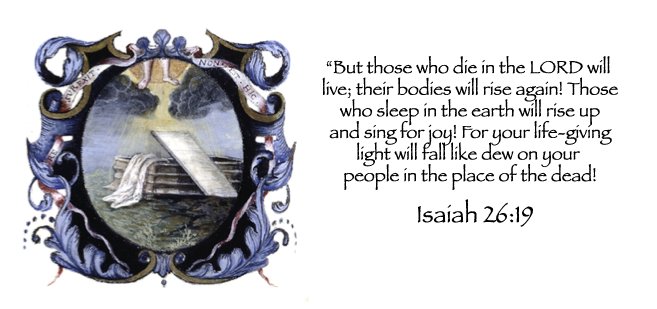
Description of Christian Clip Art: prophecy about the resurrection of the saints in Christ, medallion with the feet of Christ at the top raising from the empty tomb, clouds, O or medallion from an old manuscript, white background
Therefore prophesy and say to them, 'Thus says the Lord GOD,
"Behold, I will open your graves and cause you to come up out
 of your graves, My people; and I will bring you into the land
of Israel. Then you will know that I am the LORD, when I have
opened your graves, O my people, and brought you up
out of your graves" Ezekiel 37:12,13
"But those who die in the LORD will live; their bodies will rise again!
 Those who sleep in the earth will rise up and sing for joy!
 For your life-giving light will fall like dew on your people in the place
of the dead! Isaiah 26:19
"I know that my redeemer lives, and that in the end he will stand on the earth.
And after my skin has been destroyed, yet in my flesh I will see God;
 I myself will see him with my own eyes--I, and not another.
 How my heart yearns within me!" Job 19: 25-27
Have a question about the Christian Clip Art? Just type it in the comment box and I'll get back to you as soon as possible. I only publish content that is closely related to the subject folks.

Friday, May 4, 2018

"Shalom"

Portrait of Christ taken from a selected area of a larger work.
Description of the illustration: painting of Jesus by Kathy Grimm, text "Shalom", portrait of Christ in oil paints, Shalom means "Peace", "Shalom" is one of the sacred names of God, Jesus came in peace and gave his life as a ransom for many...

Shalom (Hebrew: שָׁלוֹםshalom; also spelled as sholom, sholem, sholoim, shulem) is a Hebrew word meaning peace, harmony, wholeness, completeness, prosperity, welfare and tranquility and can be used idiomatically to mean both hello and goodbye.

Have a question about the illustration? Just type it in the comment box and I'll get back to you as soon as possible. I only publish content that is closely related to the subject folks.
 
"How deep the Father's love for us" 
by AustinStoneWorship

Knock and the door will be opened...

"Ask and it will be given to you, seek and you will find,
knock and the door will be opened to you."
 Matthew 7:7 (NIV) in gold and blue
Description of the illustration: door knocker with a Magen David symbol, star of David, knock and Jesus will answer, seek him with all your heart, Star of David

"Ask and it will be given to you, seek and you will find,
knock and the door will be opened to you."
 Matthew 7:7 (NIV) in white and blue
"Ask and it will be given to you, seek and you will find,
knock and the door will be opened to you."
Matthew 7:7 (NIV) in greyscle
Have a question about the illustration? Just type it in the comment box and I'll get back to you as soon as possible. I only publish content that is closely related to the subject folks.

Thursday, May 3, 2018

King Solomon Makes Sacrifices

Description of the illustration: black and white illustration, Jewish priesthood, ceremonial robes, temple, incense, Solomon

Have a question about the illustration? Just type it in the comment box and I'll get back to you as soon as possible. I only publish content that is closely related to the subject folks.
Wednesday, July 12, 2017

The Ark of The Covenant


Description of the Illustration: black and white, angels, Holy, cherubim, gold, altar, Mercy Seat, ark,
       "They are to make an ark of acacia wood, 45 inches long, 27 inches wide, and 27 inches high. Overlay it with pure gold; overlay it both inside and out. Also make a gold molding all around it. Cast four gold rings for it and place them on its four feet, two rings on one side and two rings on the other side. Make poles of acacia wood and overlay them with gold. Insert the poles into the rings on the sides of the ark in order to carry the ark with them. The poles are to remain in the rings of the ark; they must not be removed from it. Put the tablets of the testimony that I will give you into the ark. Make a mercy seat of pure gold, 45 inches long and 27 inches wide. Make two cherubim of gold; make them of hammered work at the two ends of the mercy seat.  Make one cherub at one end and one cherub at the other end. At its two ends, make the cherubim of one piece with the mercy seat. The cherubim are to have wings spread out above, covering the mercy seat with their wings, and are to face one another. The faces of the cherubim should be toward the mercy seat.  Set the mercy seat on top of the ark and put the testimony that I will give you into the ark. I will meet with you there above the mercy seat, between the two cherubim that are over the ark of the testimony; I will speak with you from there about all that I command you regarding the Israelites." Exodus 25:10-22 (Holman Christian Standard Bible)
 
Ark of The Covenant as seen from it's ends.

The Ark of The Covenant simplified illustration for Chrismon Pattern.

Scriptures Given for Chrismons Including The of Ark of The Covenant at Christmas:
  • ''There was nothing in the ark except the two tablets of stone which Moses put there at Horeb, where the LORD made a covenant with the sons of Israel, when they came out of the land of Egypt.'' 1 Kings 8:9
  • ''There I will meet with you; and from above the mercy seat, from between the two cherubim which are upon the ark of the testimony, I will speak to you about all that I will give you in commandment for the sons of Israel.'' Exodus 25:22

Have a question about the illustration? Just type it in the comment box and I'll get back to you as soon as possible. I only publish content that is closely related to the subject folks.

Tuesday, July 11, 2017

Wearing the Tallit by Alphonse Levy

Description of the illustration: woodcut, Jewish, Rabbi, shawl, reading in the temple

In addition to the morning prayers of weekdays, Shabbat and holidays, a tallit gadol is also worn for Selichos in Ashkenazic communities by the prayer leader, even though it is still night. A tallit is also worn at night on Yom Kippur, from Kol Nidre, which begins during the daylight hours until after the evening (Ma'ariv) service.

Have a question about the illustration? Just type it in the comment box and I'll get back to you as soon as possible. I only publish content that is closely related to the subject folks.

Jewess of Samarkand

Description of the illustration: fine drawing, native costume, headdress, Bukharan Jews, Russian, greyscale

Have a question about the illustration? Just type it in the comment box and I'll get back to you as soon as possible. I only publish content that is closely related to the subject folks.

Monday, July 10, 2017

Blessing the new moon...

"From now on, this month will be the first month of the year
 for you. Announce to the whole community of Israel that on
 the tenth day of this month each family must choose a
lamb or a young goat for a sacrifice, one animal for each
household." Exodus 12:2-3 (NLT)
       Kiddush Levanah (Hebrew: קידוש לבנה; trans. Sanctification of the Moon) is a Jewish ritual, performed outside at night, in which a series of prayers are recited to bless the new moon.
       The source of the Kiddush Levana is in the Babylonian Talmud, (Sanhedrin 42a), Rabbi Yochanan taught that one who blesses the new moon, in its proper time, is regarded like one who greets the Shechinah (Divine Presence), as it is written in Exodus 12:2:, "This month (is to be for you the beginning of months..)”
       This verse in Exodus 12:2 is the source of what is considered to be the first commandment in the Torah, which is to sanctify the new month, and is based on the lunar calendar. Although Kiddush levana is not the method of sanctifying the new month, we may be able to understand Rabbi Yochanan's opinion that one who ‘blesses the new moon’, is also showing respect to the first commandment in the Torah, and therefore it is like greeting the Shechinah (Divine Presence).
       Many synagogues post the text of the prayer in large type on an outside wall. Read more...

Friday, April 28, 2017

The Holy Of Holies in Liturgical Colors

"The Holy of Holies" title in blue, white and black combined, transparent background

Description of the illustration: Cherubim, wings, banner, title, text "The Holy Of Holies"
"The Holy of Holies" title in gold, white and black combined, transparent background

"The Holy of Holies" title in green, white and black combined, transparent background

"The Holy of Holies" title in red, white and black combined, transparent background

"The Holy of Holies" title in violet, white and black combined, transparent background
  
Have a question about the illustration? Just type it in the comment box and I'll get back to you as soon as possible. I only publish content that is closely related to the subject folks.

Thursday, March 30, 2017

Jewish Marriage Ceremonies

Marriage ceremony among Nuremberg Jews, early 18th Century, from Kirchner 1726.
Description of Illustrations: black and white drawings and prints of Jewish marriage ceremonies, Chuppahs (canopies), Kiddushin (blessings) with two cups of wine

Marriage Scene at Kraków.

Marriage Ceremony. From a Passover Haggadah, Amsterdam, 1695.
Have a question about the illustration? Just type it in the comment box and I'll get back to you as soon as possible. I only publish content that is closely related to the subject folks.

Wednesday, March 22, 2017

A 16th Century Pomegranate Design for Chrismons

16th Century Pomegranate Design.
       This pomegranate design comes from the sixteenth century. 
       Pomegranates are not nearly as commonplace as other emblems in the Christian church. In fact, a large proportion of the pomegranates turn out to be pineapples when examined closely. Pomegranates in later centuries often are depicted in the royal badges of the Tudors, and are not intended to be church emblems at all.
       The fruit was, however, an accepted symbol of the richness of Divine Grace, and is either shown split open, with the abundant seeds of new life showing, or it is "voided," and the sacred monogram occupies the space. Certainly, after the rose, it was the favorite flower on which the broiderers showed their skill. 
       For those of you crafting Chrismons strickly in white and gold, I would suggest perhaps the exception to this rule of practice be made. For the seeds central to the pattern here would be lovely in a brilliant, bloody red and an appropriate color choice this would be too, for the seed of Christ is often associated with his precious blood. 
       There is also a crown included at the top of this pomegranate as well. (symbolic for Christ) A unique design for Chrismon collectors and crafters everywhere.

Scripture References for The Pomegranate Chrismon:
  •  "But he giveth more grace. Wherefore he saith, God resisteth the proud, but giveth grace unto the humble." James 4:6 (KJB)
  • "Let us therefore come boldly unto the throne of grace, that we may obtain mercy, and find grace to help in time of need." Hebrews 4:16 (KJB) 
pomegranate bursting open design

Medallion shaped pomegranate pattern.

More About Pomegranate Symbolism:

The Magen David Symbol

The Magen David is the Star of David.
     During the 19th century the symbol began to proliferate amongst the Jewish communities of Eastern Europe, ultimately being used amongst the Jewish communities in the Pale of Settlement. A significant motivating factor was the desire to imitate the influence of the Christian cross. The earliest Jewish usage of the symbol was inherited from medieval Arabic literature by Kabbalists for use in talismanic protective amulets (segulot) where it was known as a Seal of Solomon. The symbol was also used in Christian churches as a decorative motif many centuries before its first known use in a Jewish synagogue. Before the 19th century, official use in Jewish communities was generally known only in the region of today's Czech Republic, Austria and possibly parts of Southern Germany, having begun in medieval Prague.

Scripture References for the Magen David Chrismon:
  • "When thy days are fulfilled, and thou shalt sleep with thy fathers, I will set up thy seed after thee, that shall proceed out of thy body, and I will establish his kingdom. He shall build a house for My name, and I will establish the throne of his kingdom for ever." 2 Samuel 7:12-13 (JPS Tanakh 1917)
  • "And as Jesus passed on from there, two blind men followed him, crying aloud, “Have mercy on us, Son of David.” Matthew 9:27 (ESV)
  • ""What do you think about the Messiah? Whose son is he?" "The son of David," they replied. He said to them, "How is it then that David, speaking by the Spirit, calls him 'Lord'? For he says, "'The Lord said to my Lord: "Sit at my right hand until I put your enemies under your feet."' If then David calls him 'Lord,' how can he be his son?" No one could say a word in reply, and from that day on no one dared to ask him any more questions." Matthew 22: 42-46 (NIV)
More About David's Star:

Friday, March 10, 2017

Black and white clip art of a Jewish scribe...


Description of the illustration: church elder, greyscale drawing, prayer shawl, scroll, beard, phylactery

Have a question about the illustration? Just type it in the comment box and I'll get back to you as soon as possible. I only publish content that is closely related to the subject folks.

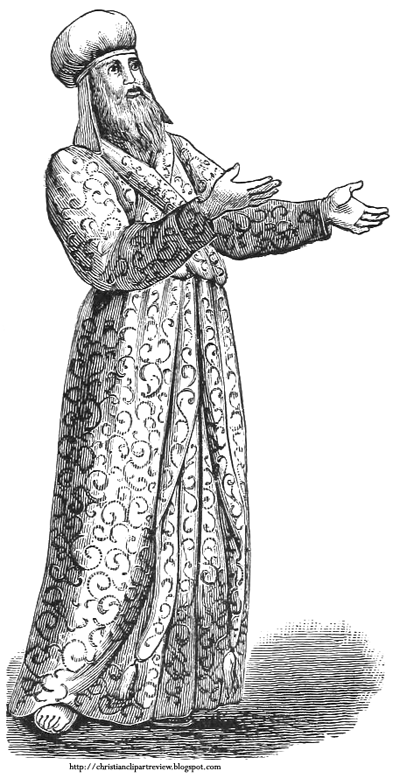
The Costume of a Jewish Priest


Description of the illustration: church elder, greyscale drawing, outreaching arms, open arms, giving and receiving

Kohen or cohen (or kohain; Hebrew: כֹּהֵן‎, "priest", pl. כֹּהֲנִיםkohanim) is the Hebrew word for priest used colloquially in reference to the Aaronic priesthood. Jewish kohanim are traditionally believed and halakhically required to be of direct patrilineal descent from the biblical Aaron. The term is colloquially used in Orthodox Judaism in reference to modern day descendants of Aharon, brother of Moses. Read more...

Have a question about the illustration? Just type it in the comment box and I'll get back to you as soon as possible. I only publish content that is closely related to the subject folks.

A drawing of a Jewish High Priest in Biblical times.

The Phylactery

Black and white phylactery.
Description of the illustration: black and white drawing,  The practice of using phylacteries was founded on a literal interpretaion of Ex.13:9,16; Deut. 6:8; 11:18, where God commands the Hebrews to bear the Law in their hearts and in their heads, and it is still continued in our days. There are two kinds of phylacteries - one to worn on the forehead, between the eyebrows, and another to be worn on the left arm. The former was called a "frontlet," and was composed of four pieces of parchment, on the first of which was written Ex. 12:2-10; on the second, Ex. 13: 11-21; on the third Deut. 6:4-9; and on the fourth, Deut. 11:18-21. These pieces of parchment, thus inscribed, were inclosed in a piece of tough skin, making a square, on one side of which was placed the Hebrew letter shin, and this box was tied to the forehead with a thong or riband. Some wore them both evening and morning, and others only at morning prayer. Dictionary of Bible

Have a question about the illustration? Just type it in the comment box and I'll get back to you as soon as possible. I only publish content that is closely related to the subject folks.

The Medieval Stars of David

Description of the illustration: Stars of David, Magen David, three versions in shades of blue and one of those combines blue and gold, transparent background
 
The Jewish Encyclopedia cites a 12th-century Karaite document as the earliest Jewish literary source to mention a symbol called "Magen Dawid" (without specifying its shape).

The name 'Shield of David' was used by at least the 11th century as a title of the God of Israel, independent of the use of the symbol. The phrase occurs independently as a Divine title in the Siddur, the traditional Jewish prayer book, where it poetically refers to the Divine protection of ancient King David and the anticipated restoration of his dynastic house, perhaps based on Psalm 18, which is attributed to David, and in which God is compared to a shield (v. 31 and v. 36). The term occurs at the end of the "Samkhaynu/Gladden us" blessing, which is recited after the reading of the Haftara portion on Saturday and holidays.

The earliest known text related to Judaism which mentions a sign called the "Shield of David" is Eshkol Ha-Kofer by the Karaite Judah Hadassi, in the mid-12th century CE:
Seven names of angels precede the mezuzah: Michael, Gabriel, etc. …Tetragrammaton protect you! And likewise the sign, called the "Shield of David", is placed beside the name of each angel.
This book is of Karaite, and not of Rabbinic Jewish origin, and it does not describe the shape of the sign in any way.
Have a question about the illustration? Just type it in the comment box and I'll get back to you as soon as possible. I only publish content that is closely related to the subject folks.

Tuesday, March 7, 2017

Etrog clip art for Sukkot

In the Chassidic community, some Jews pickle or candy the etrog (citron) from Sukkot and eat it on Tu BiShvat. Some pray that they will be worthy of a beautiful etrog on the following Sukkot.
Description of Illustration: two versions of the same illustration one in monochromatic yellow shades the other in green and yellow, etrog fruit
      Rabbinic Judaism believes the Biblical phrase peri eitz hadar (פְּרִי עֵץ הָדָר) refers to the etrog. Grammatically, the Hebrew phrase is ambiguous; it is typically translated as "fruit of a beautiful tree," but it can also be read as "a beautiful fruit of a tree." Etrogs are carefully selected for the performance of the Sukkot holiday rituals.       
      In modern Hebrew, hadar refers to the genus Citrus. Nahmanides (1194 – c. 1270) suggests that the word was the original Hebrew name for the citron. According to him, the word etrog was introduced over time, adapted from the Aramaic. The Arabic name for the citron fruit, itranj (اترنج), mentioned in hadith literature, is also associated with the Hebrew. A hadar in Greek is hydro, which means it needs a lot of water. The hydro tree needs a lot of water and a etrog needs a lot of water.
 Have a question about the illustration? Just type it in the comment box and I'll get back to you as soon as possible. I only publish content that is closely related to the subject folks.