Showing posts with label Jesse Tree Symbols. Show all posts

Monday, November 27, 2017

Jesse Tree Ornament: The "I" Scroll

"Therefore my people go into exile for lack of knowledge; their honored men go hungry, and their multitude is parched with thirst." Isaiah 5:13 (NSV)

and/or

"But the people have not returned to rely on him who struck them, nor have they sought the LORD of the Heavenly Armies." Isaiah 9:13 (ISV)

       The regard in which Isaiah is held is so high that the book is frequently called "the Fifth Gospel", the prophet who spoke more clearly of Christ and the Church than any others. Its influence extends beyond the Church and Christianity to English literature and to Western culture in general, from the libretto of Handel's Messiah to a host of such everyday phrases as "swords into ploughshares" and "voice in the wilderness".
       The Gospel of John quotes Isaiah 6:10 and states that "Isaiah said this because he saw Jesus’ glory and spoke about him." Isaiah makes up 27 of the 37 quotations from the prophets in the Pauline epistles, and takes pride of place in the Gospels and in Acts of the Apostles. Isaiah 7:14, where the prophet is assuring king Ahaz that God will save Judah from the invading armies of Israel and Syria, forms the basis for Matthew 1:23's doctrine of the virgin birth, while Isaiah 40:3–5's image of the exiled Israel led by God and proceeding home to Jerusalem on a newly constructed road through the wilderness was taken up by all four Gospels and applied to John the Baptist and Jesus.
       Isaiah seems always to have had a prominent place in Jewish Bible use, and it is probable that Jesus himself was deeply influenced by Isaiah. Thus many of the Isaiah passages that are familiar to Christians gained their popularity not directly from Isaiah but from the use of them by Jesus and the early Christian authors – this is especially true of the Book of Revelation, which depends heavily on Isaiah for its language and imagery.
A baker's clay version of a "I" scroll, symbolic for the prophet Isaiah. Both ends are rolled toward each other with the inside text made invisible to the reader.
"For unto us a child was born..." Handel's Messiah

Jesse Tree Ornament: The "J" Scroll

"For the time is coming," says the LORD, "when I will raise up a righteous descendant from King David's line. He will be a King who rules with wisdom. He will do what is just and right throughout the land." Jeremiah 23:5 (NLT)

Jeremiah also foreshowed the miraculous conception of Christ, (Jer. 31:22) the virtue of his atonement, the spiritual character of his covenant, and the inward efficacy of his laws, Jer. 31: 31-36. 33:8.
A baker's clay version of a "J" scroll. Symbolic for the prophet Jeremiah. The bottom end is rolled to the front of the scroll  and the top end is rolled to the back side of the scroll.

Jesse Tree Ornament: The "E" Scroll


"And I will make a covenant of peace with them, an everlasting covenant. I will give them their land and increase their numbers, and I will put my Temple among them forever." Ezekiel 37:26

Ezekiel was also a contemporary of Jeremiah, and like him he was also of the sacerdotal race.

       Sacerdotalism is the belief that propitiatory sacrifices for sin require the intervention of a priest. That is, it is the belief that a special, segregated order of men, called the Levitical Priesthood, are the only ones who can commune directly with God or the gods. This system of priesthood is exemplified by the Aaronic priests in the Old Testament.
       The term sacerdotalism comes from the Latin sacerdos, priest, literally one who presents sacred offerings (from sacer, "the sacred", and dare, "to give"); offerer of sacrifices. The related Latin term sacerdotium refers to the earthly hierarchy (of priests, bishops, etc.) whose primary goal is the salvation of the soul.

Right, A baker's clay version of the "e" scroll, symbolic for the prophet Ezekiel. This is basically an open scroll with two ends rolled slightly out but facing inward. The text would be revealed.

Monday, November 20, 2017

Jesse Tree Ornament - The Ram

"And Abraham lifted up his eyes, and looked, and behold behind him a ram caught in a thicket by his horns: and Abraham went and took the ram, and offered him up for a burnt offering in the stead of his son. And Abraham called the name of that place Jehovahjireh: as it is said to this day, In the mount of the LORD it shall be seen." Genesis 22:13-14 (KJB)
Patterns for crafting a ram symbol for your Jesse tree.
       In Judaism, the qorban is any of a variety of sacrificial offerings described and commanded in the Torah. The most common usages are animal sacrifice (zevah זֶבַח), zevah shelamim (the peace offering) and olah (the "holocaust" or burnt offering). A qorban was an animal sacrifice, such as a bull, sheep, goat, deer or a dove that underwent shechita (Jewish ritual slaughter). Sacrifices could also consist grain, meal, wine, or incense.
       The Hebrew Bible says that Yahweh commanded the Israelites to offer offerings and sacrifices on various altars. The sacrifices were only to be offered by the hands of the Kohanim. Before building the Temple in Jerusalem, when the Israelites were in the desert, sacrifices were offered only in the Tabernacle. After building Solomon's Temple, sacrifices were allowed only there. After the Temple was destroyed, sacrifices was resumed when the Second Temple was built until it was also destroyed in 70 CE. After the destruction of the Second Temple sacrifices were prohibited because there was no longer a Temple, the only place allowed by halakha for sacrifices. Offering of sacrifices was briefly reinstated during the Jewish–Roman wars of the second century CE and was continued in certain communities thereafter.

A painted salt clay ornament of a ram for the Jesse Tree.

Jesse Tree Ornament - The Fish

"Arise, go unto Nineveh, that great city, and preach unto it the preaching that I bid thee." Jonah 3:2 (KJB)
Two patterns for the Jesse Tree fish symbol.
   
       "As early as the days of the Church in the Catacombs we find the Holy Sacrament of Baptism symbolically represented. The most frequent symbol is a fish: it frequently appears upon the tombs of the departed Christians, indicating that they who are buried were baptized into the Church of Christ by water, the only element in which fish can exist.
       From these early times, and throughout the whole of the Middle Ages, the Fish retained its signification and continued to be used.
        Sometimes three fishes were represented entwined in a triangular fashion: doubtless this was intended to symbolize Baptism under the immediate sanction and blessing of the Divine Trinity." Audsley.
        The Fish most often used on a Jesse Tree, however, is symbolic for the great fish that carried the prophet Jonah to a distant city called, Nineveh. Modern Christian's often prefer the depiction of a whale as being the creature to secure Jonah's passage through the sea. 
Color suggestion for painting the fish symbol.
A baker's clay version of a fish pattern above.

Thursday, July 27, 2017

Jesse Tree Ornaments - The Burning Bush

"And the angel of the LORD appeared unto him in a flame of fire out of the midst of a bush: and he looked, and, behold, the bush burned with fire, and the bush was not consumed." Exodus 3:2 (KJB)
Patterns for crafting a burning bush symbol for your Jesse tree.
Color suggestion for painting
the burning bush symbol.
       Burning Bush, that in which the Lord appeared to Moses at the foot of mount Horeb. Exodus 3:2 Such was the splendor of the Divine Majesty, that its effulgence dazzled his sight, and he was unable to behold it; and in token of his humanity, submission and reverence, "Moses his his face." So did Elijah in after-times. 1 Kings 19:12. Yea, the very angels cover their faces in the presence of God. Isaiah 6:2. When the Hebrew lawgiver, just before his death, pronounced his blessing upon the chosen tribes, he called to mind this remarkable event and supplicated in behalf of the posterity of Joseph, "the good will of him that dwelt in the bush," Deuteronomy 33:16. 
       These last words of Moses seem to indicate, that there was, in this memorable transaction, something of an allegorical or mystical import, though there are different opinions as to the particular thing that it was designed to shadow forth. Some have thought that Jehovah dwelling in the bush, in a blaze of fire, and the former not being consumed by it, might possibly be intended as an emblem of godliness which was exhibited in the fullness of the times, when "the WORD, who was with God, and was God, and by whom all things were created, was made flesh, and tabernacled (to tent) among men"--the brightness of the Father's glory, and in whom all the fullness of the Godhead dwelt bodily. 1 John 1:1-14 and Col. 1: 15-19; ch.2:9. And this was the truth, reality, and ultimate import of the Shechinah, there can be no reasonable doubt. But others consider that the particular thing intended to be taught the Hebrews by this phenomenon, namely, the bush of thorns or briars, burning yet not consumed, was to intimate to them that God was present with them in their great affliction and tribulations, and, by his providence, so ordering matters that their afflictions did not consume them; agreeably to the words of the prophet: "In all their afflictions he was afflicted, and the angel of his presence saved them." Isaiah 63:9 "This fire, also," says bishop Patrick, "might be intended to show that God would there meet with the Israelites and give them his law in fire and lightning, and yet not consume them." Jones.
A baker's clay sample of the burning bush ornament.

Thursday, July 20, 2017

Jesse Tree Ornament - The Crown

"David was thirty years old when he began to reign, and he reigned forty years. In Hebron he reigned over Judah seven years and six months: and in Jerusalem he reigned thirty and three years over all Israel and Judah."  2 Samuel 5:4 (KJB)
Patterns for crafting a crown of David symbol for your Jesse tree.

A color suggestion for painting the crown of David symbol.
       King David  was, according to the Hebrew Bible, the second king of the United Kingdom of Israel and Judah, reigning in c. 1010–970 BC.
       Depicted as a valorous warrior of great renown, a poet, and musician credited for composing many of the psalms contained in the Book of Psalms, King David is viewed in biblical sources as a righteous and effective king both in battle and in providing civil and criminal justice. He is described as a man after God's own heart in "But now thy kingdom shall not continue: the LORD hath sought him a man after his own heart, and the LORD hath commanded him to be captain over his people, because thou hast not kept that which the LORD commanded thee." 1 Samuel 13:14 and "And when he had removed him, he raised up unto them David to be their king; to whom also he gave testimony, and said, I have found David the son of Jesse, a man after mine own heart, which shall fulfill all my will." Acts 13:22.
       The Hebrew prophets regarded him as the ancestor of the future messiah. The New Testament says he was an ancestor of Jesus.

Baker's clay version of a crown of David symbol.

Jesse Tree Ornament - The Natal Star

"When they had heard the king, they departed; and, lo, the star, which they saw in the east, went before them, till it came and stood over where the young child was." Matthew 2:9 (KJB)
Patterns for crafting a natal star symbol for your Jesse tree.

       The Star of Bethlehem, or Christmas Star, appears only in the nativity story of the Gospel of Matthew, where "wise men from the East" (Magi) are inspired by the star to travel to Jerusalem.There they meet King Herod of Judea, and ask where the king of the Jews had been born. Herod, following a verse from the Book of Micah interpreted as a prophecy, directs them to Bethlehem, to the south of Jerusalem. The star leads them to Jesus' home in the town, where they worship him and give him gifts. The wise men are then given a divine warning not to return to Herod so they return home by a different route.
       Many Christians believe the star was a miraculous sign to mark the birth of the Christ (or Messiah). Some theologians claimed that the star fulfilled a prophecy, known as the Star Prophecy. Astronomers have made several attempts to link the star to unusual astronomical events, such as a conjunction of Jupiter and Venus, a comet or a supernova.
       The subject is a favorite at planetarium shows during the Christmas season, although the Biblical account describes Jesus with a broader Greek word, which can mean either "infant" or "child" (paidon), rather than the more specific word for infant (brephos), possibly implying that some time has passed since the birth. The visit is traditionally celebrated on Epiphany (January 6) in Western Christianity.

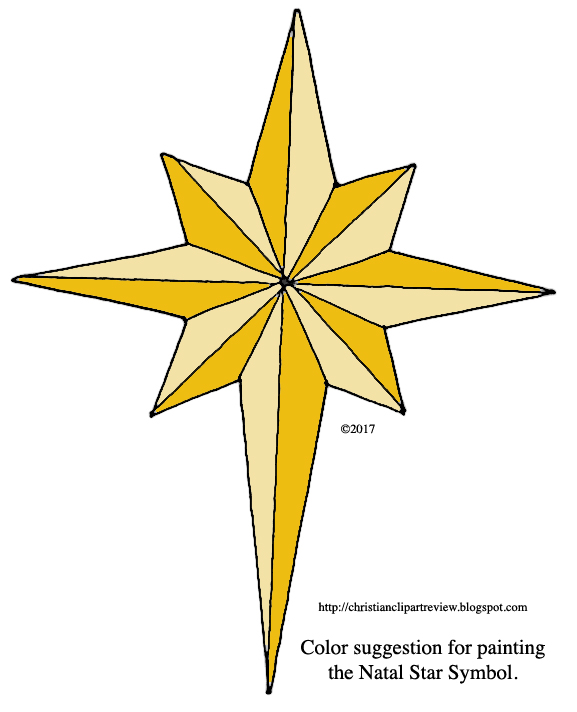
       Natal stars, whether they have four points or eight are generally used to reference the star that directed the wise men to see baby Jesus. There are three reasons behind this selection.
  1.  The first being that the shorter arms of the horizontal points and the longer arm of the lowest point configure a cross shape. This shape serves as a reminder of Christ's death on a cross. 
  2. The second reason being the association with the wise men or three kings to astrology. They used the star of Bethlehem to guide them to the baby's location. Astrology charts, compasses and other items used by those who study the stars often depict natal stars.
  3.  And the third reason, the term natal means something relating to the place or time of a person's birth.
A color suggestion for painting the natal star symbol.
A sample of the natal star made with baker's clay.

Jesse Tree Ornament - The Candle

"In him was life; and the life was the light of men." John 1:4 (KJB)
Patterns for crafting the candle symbol for your Jesse tree.
A color suggestion for painting the candle symbol.
      Light frequently signifies instruction both by doctrine and example; "Let your light so shine before men, that they may see your good works, and glorify your Father which is in heaven." Matthew 5:16 and "He was a burning and a shining light: and ye were willing for a season to rejoice in his light." John 5:35 or persons considered as giving light, "You are the light of the world. A city set on a hill cannot be hidden;" Matthew 5:14 and "And art confident that thou thyself art a guide of the blind, a light of them which are in darkness," Romans 2:19. It is applied in the highest sense to Christ, the true light,the Sun of Righteousness, who is that in the spiritual, which the material light is in the natural world; who is the great Author, not only of illumination and knowledge, but of spiritual life, health, and joy to the souls of men.

A baker's clay example of the candle symbol.

Jesse Tree Ornament - the Ark

"And GOD saw that the wickedness of man was great in the earth, and that every imagination of the thoughts of his heart was only evil continually. And it repented the LORD that he had made man on the earth, and it grieved him at his heart.And the LORD said, I will destroy man whom I have created from the face of the earth; both man, and beast, and the creeping thing, and the fowls of the air; for it repenteth me that I have made them. But Noah found grace in the eyes of the LORD." Genesis 6:5-8 (KJB)
Patterns for crafting an ark symbol for your Jesse tree.
The term thebeth, Hebrew for Ark, used by Moses is different from the common name by which he describes a coffer; and is the same that he employs when speaking of the little wicker basket in which he was exposed on the Nile; whence some have thought that the ark was of wicker-work. However, for those who believe in God's preservation through storms and trauma, the comparison made by Moses between the Ark of Noah and his wicker basket has much more to do with salvation by the grace of God. The ship or ark and his floating basket both provided protection and preservation of God's people:

 "And the daughter of Pharaoh came down to wash herself at the river; and her maidens walked along by the river's side; and when she saw the ark among the flags, she sent her maid to fetch it." Exodus 2:5 (KJB)
A color suggestion for painting the ark symbol.
       The ark is the oldest symbol used for the church as a ship in the scriptures. It is important to understand, however, that symbolic imagery is also quite literal throughout the scripture. Not only does it stand for ideas, it also is a part of literal narrative.  In other words, there was indeed an ark that preserved God's family from annihilation and the ark on the Jesse tree also represents this repetitive promise made by God throughout all of scripture, to preserve his literal family, root of Jesse, and all who are spiritually adopted into his family, the church.

"The image of the Church as a ship was one that naturally grew out of the idea of the Ark, and also was doubtless associated in the Apostles' minds with the ship which so frequently contained Him when He spoke with the multitudes. Its appearance in the catacombs, on gems and in mosaics, is very common. Its distinguishing mark is usually a cross above the mast, (in later depictions of the church as a ship) or the Holy Dove hovering over it. (The dove was used by God to bring hope of renewal to Noah after the flood. Genesis 8:11)" Jenner

A baker's clay symbol of the ark symbol.

Thursday, July 6, 2017

Jesse Tree Ornament - The Sun

"And God made two great lights; the greater light to rule the day, and the lesser light to rule the night: he made the stars also." Genesis 1:16 (KJB)
Patterns for crafting a sun symbol for your Jesse tree.

A color suggestion for painting the sun symbol.
       The sun; the great luminary which God created at the beginning, to govern the day. It furnishes a great part of the noble similitudes used by sacred authors, who to represent great public calamity, speak of the sun as being obscured, etc...
  • "For the stars of heaven and the constellations thereof shall not give their light: the sun shall be darkened in his going forth, and the moon shall not cause her light to shine." Isaiah 13:10
  • "Then the moon shall be confounded, and the sun ashamed, when the LORD of hosts shall reign in mount Zion, and in Jerusalem, and before his ancients gloriously." Isaiah 24:23
  • "She that hath borne seven languisheth: she hath given up the ghost; her sun is gone down while it was yet day: she hath been ashamed and confounded: and the residue of them will I deliver to the sword before their enemies, saith the LORD." Jeremiah 15:9
  • "And when I shall put thee out, I will cover the heaven, and make the stars thereof dark; I will cover the sun with a cloud, and the moon shall not give her light." Ezekiel. 32:7
  • "The sun shall be turned into darkness, and the moon into blood, before the great and the terrible day of the LORD come." Joel 2:31
  • "And it shall come to pass in that day, saith the Lord GOD, that I will cause the sun to go down at noon, and I will darken the earth in the clear day:" Amos 8:9
       To express a long continuance of any thing glorious and illustrious, it is said, it shall continue as long as the sun. 
  • "His name shall endure for ever: his name shall be continued as long as the sun: and men shall be blessed in him: all nations shall call him blessed." Psalm 72:17
  • "His seed shall endure for ever, and his throne as the sun before me." Psalm 89:36
So the reign of the Messiah, under whose happy dominion the light of the moon shall equal that of the sun, and that of the sun be seven times more than ordinary.
  • "Moreover the light of the moon shall be as the light of the sun, and the light of the sun shall be sevenfold, as the light of seven days, in the day that the LORD bindeth up the breach of his people, and healeth the stroke of their wound." Isaiah 30:26
Christ is called the Sun of righteousness,
  • "But unto you that fear my name shall the Sun of righteousness arise with healing in his wings; and ye shall go forth, and grow up as calves of the stall." Malachi. 4:2
The compass of the whole earth is described by the expression, from the rising of the sun to the going down of the same; or rather, from east to west, 
  • "A Psalm of Asaph. The mighty God, even the LORD, hath spoken, and called the earth from the rising of the sun unto the going down thereof." Psalm 50:1
  • "And gathered them out of the lands, from the east, and from the west, from the north, and from the south." Psalm 107:3
  • "From the rising of the sun unto the going down of the same the LORD'S name is to be praised." Psalm 113:3
A baker's clay sample of the sun symbol.

Jesse Tree Ornament - The Camel

"The LORD God of heaven, which took me from my father's house, and from the land of my kindred, and which spake unto me, and that sware unto me, saying, Unto thy seed will I give this land; he shall send his angel before thee, and thou shalt take a wife unto my son from thence." Genesis 24:7 (KJB)

Two patterns for the camel symbol.

Color suggestion for the camel symbol.
       The servant devised a test in order to find the right wife for Isaac. As he stood at the central well in Abraham's birthplace with his men and ten camels laden with goods, he prayed to God:
"And let it come to pass, that the damsel to whom I shall say, Let down thy pitcher, I pray thee, that I may drink; and she shall say, Drink, and I will give thy camels drink also: let the same be she that thou hast appointed for thy servant Isaac; and thereby shall I know that thou hast shewed kindness unto my master." Genesis 24:14
       To his surprise, a young girl immediately came out and offered to draw water for him to drink, as well as water to fill the troughs for all his camels. Rebekah continued to draw water until all the camels were sated, proving her kind and generous nature and her suitability for entering Abraham's household. The servant immediately gave her a golden nose ring and two golden bracelets (Genesis 24:22), which Rebekah hurried to show her mother. Seeing the jewelry, her brother Laban ran out to greet the guest and bring him inside. The servant recounted the oath he made to Abraham and all the details of his trip to and meeting with Rebekah in fine detail, after which Laban and Bethuel agreed that she could return with him. After hosting the party overnight, however, the family tried to keep Rebekah with them longer. The servant insisted that they ask the girl herself, and she agreed to go immediately. Her family sent her off with her nurse, Deborah (according to Rashi), and blessed her, "Our sister, may you come to be thousands of myriads, and may your offspring inherit the gate of its foes."
A baker's clay version of the camel symbol used to illustrate the
means by which a wife for Isaac was chosen. 

Jesse Tree Ornament - The Rainbow

"I do set my bow in the cloud, and it shall be for a token of a covenant between me and the earth. And it shall come to pass, when I bring a cloud over the earth, that the bow shall be seen in the cloud: And I will remember my covenant, which is between me and you and every living creature of all flesh; and the waters shall no more become a flood to destroy all flesh." Genesis 9: 13-15 (KJB)
Patterns for crafting the rainbow symbol for your Jesse tree.
Color suggestion for the rainbow symbol from Genesis.
       Promises of God, are the kind declarations of his word, in which he hath assured us he will bestow blessings upon his people.
       The promises contained in the sacred Scriptures may be considered,
   1.) Divine as to their origin.
   2.) Suitable as to their nature.
   3.) Abundant as to their number.
   4.) Clear as to their expression.
   5.) Certain as to their accomplishment.The consideration of them should,
          a.) Prove an antidote to despair.
          b.) A motive to patience.
          c.) A call for prayer.
          d.) A spur to perseverance

A baker's clay version of the rainbow symbol for a Jesse tree.

Wednesday, July 5, 2017

Jesse Tree Ornament - The Sandals

"Now the LORD had said unto Abram, Get thee out of thy country, and from thy kindred, and from thy father's house, unto a land that I will shew thee: And I will make of thee a great nation, and I will bless thee, and make thy name great; and thou shalt be a blessing:" Genesis 12: 1-4 (KJB)
and
"And the LORD appeared unto Abram, and said, Unto thy seed will I give this land: and there builded he an altar unto the LORD, who appeared unto him." Genesis 12:7 (KJB)

Patterns for cutting Abraham's sandals from baker's clay.
You will need twine and glue and an embroidery needle along with baker's clay and acrylic paints for this sandal ornament. The holes in the color version of the ornament show where you will need to thread the twine for the upper parts of the sandals. It is also important that you not add feet to your sandals for Abraham. The symbol of Abraham's sandals removed denotes absolute subjugation to God.

Color suggestion for painting the sandals of Abraham.
A baker's clay version of Abraham's sandals.
Sandals, at first, were only soles tied to the feet with strings or thongs; afterwards they were covered; and at last they called even shoes sandals. When Judith went to the camp of Holoderness, it is said she put sandals on her feet; and her sandals ravished his eyes. They were a magnificent kind of buskins, proper only to ladies of condition, and such as dressed themselves for admiration. But there were sandals also belonging to men, and of mean value.
       The business of untying and carrying the sandals being that of a servant, the expressions of the Baptist, "whose shoes I am not worthy to unloose," was an acknowledgement of his great inferiority to Christ, and that Christ was his Lord. To pull off the sandals on entering a sacred place, or the house of a person of distinction, was the usual mark of respect. They were taken care of by the attendant servant. 

Other scripture denotes distinctions made in removing the shoes: In these cases there is a necessary submission to the Lord as supreme authority.
  • "And he said, Draw not nigh hither: put off thy shoes from off thy feet, for the place whereon thou standest is holy ground." Exodus 3:5 (KJB)
  • "And David went up by the ascent of mount Olivet, and wept as he went up, and had his head covered, and he went barefoot: and all the people that was with him covered every man his head, and they went up, weeping as they went up.
    "
    2 Samuel 15:30 (KJB)
  • "At the same time spake the LORD by Isaiah the son of Amoz, saying, Go and loose the sackcloth from off thy loins, and put off thy shoe from thy foot. And he did so, walking naked and barefoot. And the LORD said, Like as my servant Isaiah hath walked naked and barefoot three years for a sign and wonder upon Egypt and upon Ethiopia;" Isaiah 20: 2-3 (KJB)
  • "And these bottles of wine, which we filled, were new; and, behold, they be rent: and these our garments and our shoes are become old by reason of the very long journey." Joshua 9:13 (KJB)
  • "Now this was the manner in former time in Israel concerning redeeming and concerning changing, for to confirm all things; a man plucked off his shoe, and gave it to his neighbour: and this was a testimony in Israel. Therefore the kinsman said unto Boaz, Buy it for thee. So he drew off his shoe." Ruth 4:7-8 (KJB)
  • "Carry neither purse, nor scrip, nor shoes: and salute no man by the way." Luke 10:4 (KJB)
Who knew shoes meant so much?

Tuesday, July 4, 2017

Jesse Tree Ornament - The Heart

"And the angel came in unto her, and said, Hail, thou that art highly favoured, the Lord is with thee: blessed art thou among women." Luke 1:28 (KJB)
Pattern for the Jesse tree heart symbol, given to the
Virgin Mary, mother of Christ.
       Mary being espoused to Joseph, the angel Gabriel appeared to her, to announce to her that she should be by a miracle of divine power, the mother of the Messiah. To confirm this message, and to show that nothing is impossible to God, he added that her cousin Elisabeth, who was old, and had been hitherto barren, was then in the sixth month of her pregnancy. Mary thus convinced, answered, "Behold, the handmaid of the Lord; be it unto me according to thy word." Luke 1:38

       The Hebrews used this word, heart, for the soul, comprehending all its feelings and faculties. Hence are derived many modes of expression. "An honest and good heart," Luke 8:15 is a heart studious of holiness, being prepared by the Spirit of God to receive the word with due affections, dispositions, and resolutions.
A painted, baker's clay heart for the Jesse tree.
       Keeping the heart is a duty enjoined in the sacred Scriptures. It consists, says Mr. Flavel, in the diligent and constant use and improvement of all holy means and duties to preserve the soul from sin, and maintain communion with God; and this, he properly observes, supposes a previous work of sanctification, which hath set the heart right by giving it a new bent and inclination. 
  1. It includes frequent observation of the frame of the heart, "I call to remembrance my song in the night: I commune with mine own heart: and my spirit made diligent search." Psalms 77:6
  2. Deep humiliation for heart evils and disorders, "Notwithstanding Hezekiah humbled himself for the pride of his heart, both he and the inhabitants of Jerusalem, so that the wrath of the LORD came not upon them in the days of Hezekiah." 2 Chronicles 32:26
  3. Earnest supplication for heart purifying and rectifying grace, "Who can understand his errors? cleanse thou me from secret faults." Psalm 19:12
  4. A constant, holy jealousy over our hearts, "He that blesseth his friend with a loud voice, rising early in the morning, it shall be counted a curse to him." Proverbs 27:14
  5. It includes the realizing of God's presence with us, and setting him before us, "I have set the LORD always before me: because he is at my right hand, I shall not be moved." Psalm 16:8 and "And when Abram was ninety years old and nine, the LORD appeared to Abram, and said unto him, I am the Almighty God; walk before me, and be thou perfect." Genesis 17:1.

Jesse Tree Ornament - The Apple

"And when the woman saw that the tree was good for food, and that it was pleasant to the eyes, and a tree to be desired to make one wise, she took of the fruit thereof, and did eat, and gave also unto her husband with her; and he did eat. And the eyes of them both were opened, and they knew that they were naked; and they sewed fig leaves together, and made themselves aprons. And they heard the voice of the LORD God walking in the garden in the cool of the day: and Adam and his wife hid themselves from the presence of the LORD God amongst the trees of the garden. And the LORD God called unto Adam, and said unto him, Where art thou?" Genesis 3:6-9 (KJB)
Apple and leaf patterns for the Jesse tree.
Color suggestion for painting the apple symbol.
        The apple has long been used to represent our most ancient of ancestors because they changed their relationship to God by eating a type of fruit from the tree of knowledge of both good and evil. Why the apple, of all fruits, got stuck with such a evil association, we may never know. But, I suspect that this unfortunate fruit was selected for the symbol because of it's connections with Adam's apple.
       There are two main theories as to the origin of the term "Adam's apple". The "Brewer's Dictionary of Phrase and Fable" and the 1913 edition of Webster's Dictionary point at an ancient belief that a piece of forbidden fruit was embedded in Adam's throat (the first man, according to Abrahamic religions). However, neither the Bible nor other Judeo-Christian or Islamic writings mention such a story. In fact, the biblical story does not even specify the type of fruit that Adam ate.
       Linguist Alexander Gode claimed that the Latin phrase to designate the laryngeal prominence was very probably translated incorrectly from the beginning. The phrase in Latin was "pomum Adami" (literally: 'Adam's apple'). This, in turn, came from the Hebrew "tappuach ha adam" meaning "apple of man". The confusion lies in the fact that in Hebrew language the proper name "Adam" (אדם) literally means "man", while the Hebrew word "apple" means "swollen", thus in combination: the swelling of a man.  Proponents of this version contend that the subsequent phrases in Latin and other Romance languages represent a mistranslation from the start.
       Nonetheless, artists throughout history seem to have selected this fruit to represent the fall of Adam and Eve no matter what any of the rest of us may say or believe in the apples' defense.
       The fall, is a topic of great importance that should not be avoided when teaching young ones. However, it may be taught in a positive way through it's association with: 
  1. The naming of the first man and woman. and...
  2. Christ's coming to save the race of man from spiritual exile.
        The apostle Paul speaks to the congregation at Corinth about the first man and woman in relationship to Christ. Christ being the second man to replace Adam and Christ being the one who saves us from the fall by defeating the serpent that had so beguiled Eve.
       Adam; the name of the first man, the progenitor of the human race. It is derived from Adamah, which, in Hebrew and in all the oriental languages, originally signifies vegetable earth, or mould; and there seems to be an allusion to this derivation in 1 Corinthians 15:47-49. where, in relation to the two great heads of the human race, the natural and supernatural, the apostle says, "The first man is of the earth, earthy: the second man is the Lord from heaven. As is the earthy, such are they also that are earthy: and as is the heavenly, such are they also that are heavenly. And as we have borne the image of the earthy, we shall also bear the image of the heavenly." Those who love God and follow Christ are eventually allowed to eat the fruit of the tree of life.
       Eve; the name of the first woman: Chava in Hebrew, is derived from the same root as chajim, life; because she was to be "the mother of all living." It is believed she was created on the sixth day, after Adam had reviewed the animals. The apostle refers to the fall when he speaks of the Eve to the early converts in 2 Corinthians 11:3 "But I fear, lest by any means, as the serpent beguiled Eve through his subtilty, so your minds should be corrupted from the simplicity that is in Christ." Through his death and resurrection, Christ redeems all that was lost through the deception of the mother of our race and restores us all to Eden.
Left, you can see that I have cut the apple from baker's clay, scratched it's surface and smoothed on a tiny bit of water before pressing the leaf gently on top of the apple's surface. Right, here I have painted my apple bright red and the leaf green and the stem brown. Seal the finished clay ornaments with clear acrylic spray after it has dried.

Monday, July 3, 2017

Jesse Tree Ornament - The Shell

"For this is he that was spoken of by the prophet Esaias, saying, The voice of one crying in the wilderness, Prepare ye the way of the Lord, make his paths straight." Matthew 3:3 (KJB)
Patterns for the Jesse Tree Shell Symbol.

Color suggestion for painting the shell symbol.
"In those days came John the Baptist, preaching in the wilderness of Judaea, And saying, Repent ye: for the kingdom of heaven is at hand." Matthew 3:1-3 (KJB)

A painted sample of the shell symbol on
the Jesse Tree.
       The baptism of John was evidently a preparatory ordinance. He came to "prepare the way of the Lord." He preached to the people that the Messiah was coming, and exhorted them to prepare to receive him; and in order that they might be prepared, called them to repentance and baptism. 
       One part of the design of John's baptism as stated by himself, shows it to have been entirely distinct from Christian baptism: "That he (Christ) should be made manifest to Israel, therefore I come baptizing with water," John 1: 31. It was an important part of the object of John's ministry and baptism, to point out the Messiah of the Jewish people, bear public testimony in his behalf, and induct him, by the washing of water, into the ministry. 
       Christian baptism originated in the express command of Christ: "Go ye and teach all nations, baptizing them in the name of the Father, and of the Son, and of the Holy Ghost." 

Jesse Tree Ornament - The Red Rope

"Behold, when we come into the land, thou shalt bind this line of scarlet thread in the window which thou didst let us down by: and thou shalt bring thy father, and thy mother, and thy brethren, and all thy father's household, home unto thee." Joshua 2:18 (KJB)
or
"By faith the harlot Rahab perished not with them that believed not, when she had received the spies with peace." Hebrews 11:31 (KJB)

For this Jesse tree symbol, roll out three long ropes of clay on a floured surface and braid these together. Paint Rahab's rope red and hang it on your Jesse tree to remember her bravery.
       Rahab; an hostess of the city of Jericho, who received and concealed the spies sent by Joshua. The Hebrew calls her zuneh, (Joshua 2:1) which Jerome and many others understand of a prostitute. Others, however, think she was only a hostess or innkeeper, and that this is the true signification of the original word, from zoom, to provide food. Had she been a woman of ill fame, would Salmon, a prince of the tribe of Judah, have taken her to wife? Or could he have done it by the law? Besides, the spies of Joshua would hardly have gone to lodge with a common harlot, they who were charged with so nice and dangerous a commission. Those who maintain that she was a harlot, pretend that she perhaps one of those women who prostituted themselves in honor of pagan deities. But such women are called kadeshah, not zuneh, in the Hebrew.
       Rahab married Salmon, a prince of Judah, by whom she had Boaz, from whom descended Obed, Jesse, and David. Thus Jesus Christ condescended to reckon this Canaanitish woman among his ancestors. St. Paul magnifies the faith of Rahab, 

Sunday, July 2, 2017

Jesse Tree Ornament - The Altar

"And Elijah came unto all the people, and said, How long halt ye between two opinions? if the LORD by God, follow him: but if Baal, then follow him. And the people answered him not a word." 1 Kings 18:21 (KJB)
Patterns for the altar symbol used to represent Elijah on the Jesse tree.

painting suggestion for the altar
"And Elijah said unto the prophets of Baal, Choose you one bullock for yourselves, and dress it first; for ye are many; and call on the name of your gods, but put no fire under. And they took the bullock which was given them, and they dressed it, and called on the name of Baal from morning even until noon, saying, O Baal, hear us. But there was no voice, nor any that answered. And they leaped upon the altar which was made. And it came to pass at noon, that Elijah mocked them, and said, Cry aloud: for he is a god; either he is talking, or he is pursuing, or he is in a journey, or peradventure he sleepeth, and must be awaked.And they cried aloud, and cut themselves after their manner with knives and lancets, till the blood gushed out upon them. And it came to pass, when midday was past, and they prophesied until the time of the offering of the evening sacrifice, that there was neither voice, nor any to answer, nor any that regarded.And Elijah said unto all the people, Come near unto me. And all the people came near unto him. And he repaired the altar of the LORD that was broken down. And Elijah took twelve stones, according to the number of the tribes of the sons of Jacob, unto whom the word of the LORD came, saying, Israel shall be thy name:  And with the stones he built an altar in the name of the LORD: and he made a trench about the altar, as great as would contain two measures of seed. And he put the wood in order, and cut the bullock in pieces, and laid him on the wood, and said, Fill four barrels with water, and pour it on the burnt sacrifice, and on the wood. And he said, Do it the second time. And they did it the second time. And he said, Do it the third time. And they did it the third time. And the water ran round about the altar; and he filled the trench also with water.  And it came to pass at the time of the offering of the evening sacrifice, that Elijah the prophet came near, and said, LORD God of Abraham, Isaac, and of Israel, let it be known this day that thou art God in Israel, and that I am thy servant, and that I have done all these things at thy word.  Hear me, O LORD, hear me, that this people may know that thou art the LORD God, and that thou hast turned their heart back again. Then the fire of the LORD fell, and consumed the burnt sacrifice, and the wood, and the stones, and the dust, and licked up the water that was in the trench.  And when all the people saw it, they fell on their faces: and they said, The LORD, he is the God; the LORD, he is the God." 1 Kings 18:25 - 39 (KJB)

Above is a painted baker's clay version of the altar symbol
representing the story of Elijah and The Prophets of Baal.

God Incinerates The Altar by Superbook.